Block 2b: Earth Systems, Second Pass: One Step at a Time
Put your Block 2 diagram on the desk (or a blank page if you did not finish one). Write one line at the top of a fresh page: which of the four spheres am I least sure about?
Task: That is the sphere you will explain to a partner in Step 2.
Answer in your Field Notebook, dated.
I can name Earth's four subsystems (atmosphere, hydrosphere, geosphere, biosphere) and give a concrete example of how two of them interact.
I can show how one change on Earth sets off feedback loops that change other Earth systems.
"Analyze geoscience data to make the claim that one change to Earth's surface can create feedbacks that cause changes to other Earth systems."
Where this runs:
- U1 B2: Earth as Baseline: Systems Thinking + Subsystems
- U1 B2.5: Earth Systems, Second Pass: One Step at a Time ← you are here
- U1 B3: Mars as Calibration: What Does Earth Have That Mars Doesn't?
- U1 B7: Habitability Framework: Building the Comparison
Assessed:
Goldilocks Report: framework criteria with feedback reasoning, esp. field 5 'where it can fail' (K/U, Component 1 locks U1 Block 7)
On track looks like:
You can run the perturbation test on a loop and say whether it amplifies or stabilizes, and your framework uses that move on real criteria.
Feedback Loops handout (in Google Classroom) · The Systems Diagrammer · Reading: Four Spheres, One System
I can model what is inside Earth, and explain how heat moving through it drives what happens on the surface.
"Develop a model based on evidence of Earth's interior to describe the cycling of matter by thermal convection."
Where this runs:
- U1 B2: Earth as Baseline: Systems Thinking + Subsystems
- U1 B2.5: Earth Systems, Second Pass: One Step at a Time ← you are here
- U1 B3: Mars as Calibration: What Does Earth Have That Mars Doesn't?
Assessed:
Goldilocks Report: the geosphere and magnetic-field criteria (K/U, Component 1 locks U1 Block 7)
On track looks like:
You can say what each layer is, how we know it is there without anyone having been down, and why a liquid moving core is what produces a magnetic field.
I ask what keeps a system steady, and what tips it into change.
In brief: "Systems can be stable or change over time; feedback and rates of change determine which."
Where this runs:
- U1 B2: Earth as Baseline: Systems Thinking + Subsystems
- U1 B2.5: Earth Systems, Second Pass: One Step at a Time ← you are here
- U1 B3: Mars as Calibration: What Does Earth Have That Mars Doesn't?
- U1 B7: Habitability Framework: Building the Comparison
- U2 B1: Weathering: How Rocks Break Down
- U2 B2: Erosion: How Earth Moves Itself Around
- U2 B6: Field Photo / Map Analysis Work Day
- U2 B7: Reading the Landscape: Worked Example + OPVL
- U3 B1: Inside Earth + Boundary Types
- U3 B2: Subduction & Transform Deep Dive + Sim Demo
- U4 B5: IPCC AR6 Deep Dive + Chennai Climate Brief Assigned
- U4 B6: Climate Models: How They Work, How They're Wrong, How to Read Them
- U4 B7: Regional Climate Change: From Global Average to Chennai's Monsoon
I follow where energy and matter go; neither appears from nowhere.
In brief: "Tracking energy and matter into, out of and within a system shows what the system can and cannot do."
Where this runs:
- U1 B1: Phenomenon Launch: What Makes a Planet Habitable?
- U1 B2: Earth as Baseline: Systems Thinking + Subsystems
- U1 B2.5: Earth Systems, Second Pass: One Step at a Time ← you are here
- U1 B3: Mars as Calibration: What Does Earth Have That Mars Doesn't?
- U1 B4: Habitable Zone, AU, Light-year: Scale of the Cosmos
- U4 B3: The Carbon Cycle: Fast + Slow
- U4 B4: Human Acceleration of Carbon + The Warming Signal
What today is about
Same target as Block 2. Fewer moving parts. One path, in order.
Block 2 asked you to do a lot at once: three readings, a handout, a sketch, a choice of three paths, an AI partner, and an exit ticket with four requirements. Some of you got there. Some of you did not, and that is fair: it was a lot for one block. So today we do it again, one step at a time, and every step tells you what "done" looks like before you start it.
The target has not changed. By the end of class you have a diagram with Earth's four spheres, three arrows with verbs, and one loop labeled + or − with a sentence saying why. That diagram is the thinking that every unit after this one builds on, which is why it is worth a second day.
No AI partner. No Field Notebook sketch. No Power outline. No readings to finish first. You need paper, a pencil, this page, and your phone for one photo at the end. If the Class Notebook header (Step 1) is a struggle, skip it and come back to it after you submit.
Start at Step 7. When you reach Step 8, pick a card from the Systems Gallery and draw it. Then submit.
The only reference you need today
Keep this open. Everything below fits on a single screen, and it is also on the printed checklist.
Help if you want it Taking notes? Power 1 seeds for today
| Sphere | What it is | Something you can see from AISC |
|---|---|---|
| Atmosphere | The air: gases around the planet | The monsoon clouds; the humidity you walk into at 3 pm |
| Hydrosphere | All the water: oceans, rivers, ice, groundwater, vapor | The Bay of Bengal; the water tanker; the Adyar river |
| Geosphere | The rock: crust, mantle, core, soil, sand | Marina Beach sand; the red laterite soil in the garden |
| Biosphere | All living things, and what they make | The crows, the neem trees, you |
Watch the diagram grow
Nine frames, one per step. Open the frame for the step you are on.
Notebook header
Four spheres, four rows
One interaction, one sentence
Draw that sentence
The return arrow
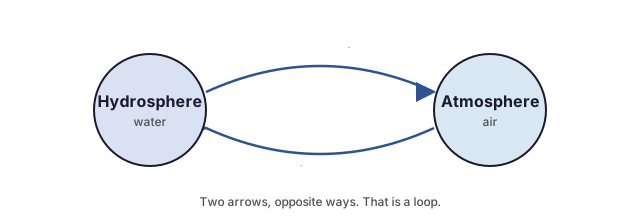
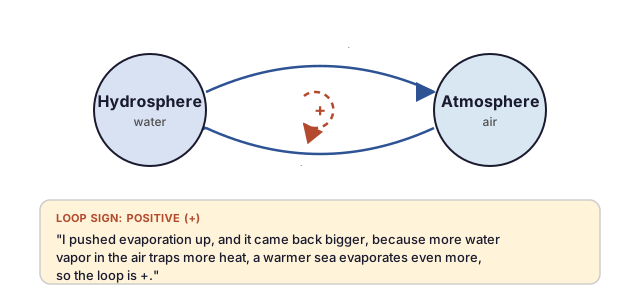
Sign the loop
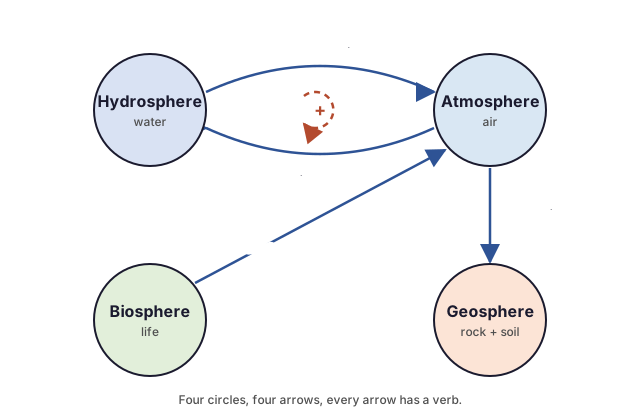
Add the other two spheres
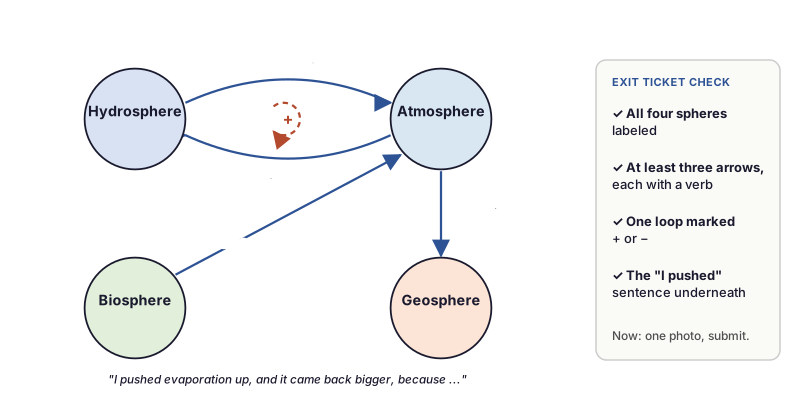
Check against the exit ticket, then submit
Reflect
The water, carbon, and oxygen cycles are the same drawing, extended
Each cycle starts as one link between two spheres (your Step 3), then grows to touch all four (your Step 7). The last column is the loop you can sign in Step 6. The back of the printed checklist has a finished example.
| Cycle | The Step 3 link | How it grows to four spheres | A loop in it you can sign |
|---|---|---|---|
| Water | Hydrosphere evaporates into atmosphere; atmosphere rains onto hydrosphere | Rain soaks into soil and rock (geosphere); rivers erode rock into the sea; plants breathe out water vapor (biosphere) | Water-vapor loop: more evaporation → more vapor → more heat trapped → more evaporation. + |
| Carbon | Biosphere takes CO₂ from atmosphere (photosynthesis); biosphere breathes CO₂ out into atmosphere (respiration) | Ocean absorbs CO₂ (hydrosphere); rain weathers rock and buries carbon as limestone (geosphere); volcanoes release it back | Rock thermostat: warmer → more rain and weathering → more CO₂ buried → less heat trapped → cooler. Comes back smaller. − |
| Oxygen | Biosphere releases O₂ into atmosphere (plants); biosphere breathes O₂ in from atmosphere (animals) | O₂ dissolves into the sea for fish (hydrosphere); O₂ rusts iron in rock and soil (geosphere) | No easy sign: oxygen is a cycle, not a feedback loop. If you started with (c), sign the carbon loop instead: more plants → less CO₂ → cooler → plants grow slower. − |
Today's work: nine steps, in order
Tick each step when you meet its "done" line. Ticks save on this device so you can close the page and come back. Times add up to 80 minutes with slack; if you are behind at Step 5, tell me and we cut Step 7.
-
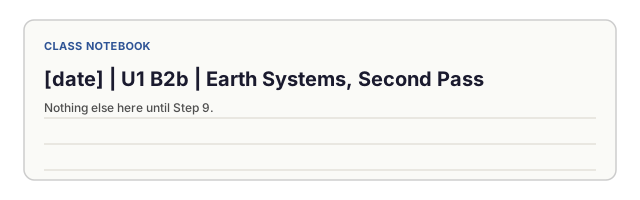
Open your Class Notebook and type today's header (it is below this list). Nothing else goes in the notebook until Step 9.
Done when: the header line is in your notebook. If this is the step that stalls you, skip it, and do it last.
-
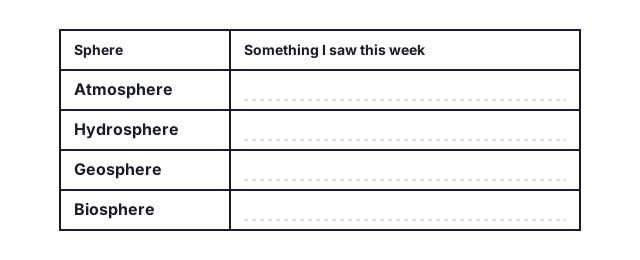
On paper, draw a table with four rows: atmosphere, hydrosphere, geosphere, biosphere. In each row write one thing that belongs to it that you have seen this week. Not from the table above: your own. Then turn to a partner and explain the sphere you wrote at the top of your page in the bell ringer. Thirty seconds each.
Done when: four rows, four examples, in your own words.
-
Pick one pair from this list. Do not pick your own today; pick from here.
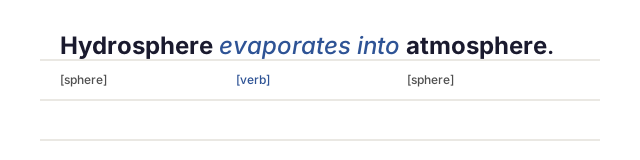
- Hydrosphere → atmosphere: the sea evaporates into the air.
- Atmosphere → geosphere: rain weathers rock.
- Biosphere → atmosphere: plants release oxygen into the air.
Write it as one sentence on your paper in this shape: [sphere] [verb] [sphere].
Done when: one sentence, with a verb, naming two spheres.
-
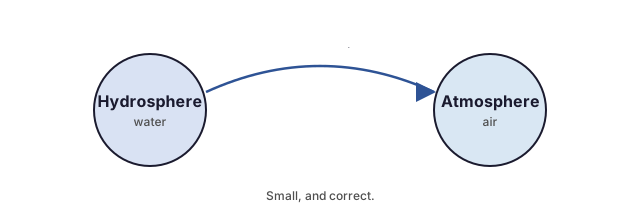
Two circles, one arrow. Write the sphere names inside the circles and the verb on the arrow. That is a systems diagram. It is small, and it is correct.
Done when: two labeled circles, one arrow, one verb on the arrow.
-
Something goes back the other way. Ask: what does the second sphere send back to the first? For the sea and the air, the air rains onto the sea. For rain and rock, the rock releases dissolved minerals into the water. For plants and air, the air gives CO₂ to the plants. Draw the second arrow, with its verb. You now have a loop.
Done when: two arrows between the same two circles, pointing opposite ways, each with a verb.
-
Run the sign test from the Concepts box. Push one thing up (more evaporation, more rain, more plants). Follow both arrows round once. Did the push come back bigger (+) or smaller (−)? Write + or − next to the loop, and under the diagram write one sentence starting with "I pushed ___ up, and it came back ___ because ___."
Done when: a + or − on the loop, and the "I pushed" sentence underneath. Unsure of your sign? That is fine: write your best sign and say why. We check signs together at the end.
-
Draw the two spheres you have not used yet as two more circles. Connect each one to your diagram with one arrow and one verb. The cycles table in Concepts gives you the arrows for whichever starter you picked: the water cycle grows with soaks into and breathe out, the carbon cycle with absorbs and buries. Or use your Step 2 table for ideas: if you wrote "neem tree" under biosphere, what does a tree do to the soil (geosphere)? Its roots break up rock. That is your arrow.
Done when: four circles, at least three arrows in total, every arrow has a verb.
-
Before you take the photo, tick these four on your paper:
- All four spheres labeled
- At least three arrows, each with a verb
- One loop marked + or −
- The "I pushed" sentence under the diagram
Take one photo. Submit it in Google Classroom using the button in the Show section below. If your Block 2 diagram exists, put it beside today's in the same photo.
Done when: Classroom says "Turned in."
-
Open the Reflection Journal from the Reflect section at the bottom. One question, a few sentences. Then, if you skipped Step 1, do the notebook header now.
Done when: the journal entry is saved.
Open your Class Notebook and type today's entry header as Heading 2:
A: Sep 9 | U1 B2b | Earth Systems, Second PassB: Sep 10 | U1 B2b | Earth Systems, Second Pass
What you're submitting today
Your systems diagram, second pass. Formative: feedback only, no band. Maps to T/T Thinking.
One photo of your diagram with all four spheres labeled, at least three arrows with verbs, one loop marked + or −, and the "I pushed" sentence underneath. That is the same target as Block 2 with one requirement removed: the buried-matter sentence is today's reflection question instead.
Submit via Google Classroom (link posted in August)One question before you leave
Three to five minutes. Your answer is saved to your reflection journal, where you can read back everything you have written this year.
Which step today was the one where the diagram started to make sense, and what changed at that step?
Today's reflection is in Google Classroom, under Reflection Journal.
Link posted in AugustSign in with your school account. Your teacher can see what you write here.
atmosphere noun
The air: the layer of gases around the planet.
From AISC: the monsoon clouds, the humidity you walk into at 3 pm.
hydrosphere noun
All the water on Earth, in every form: oceans, rivers, ice, groundwater, water vapor.
From AISC: the Bay of Bengal, the water tanker, the Adyar river.
geosphere noun
The rock: crust, mantle, core, and the soil and sand made from them.
From AISC: Marina Beach sand, the red laterite soil in the garden.
biosphere noun
All living things, and what they make.
From AISC: the crows, the neem trees, you.
systems diagram noun
A drawing of parts as labeled circles and the ways they affect each other as arrows with verbs on them.
Two circles and one arrow with a verb is already a systems diagram. Everything after that is the same drawing, extended.
feedback loop noun
Two or more arrows that go round and come back to where they started, so a change in one part comes back to affect that same part.
A loop gets a sign, + or −. A cycle (water, carbon, oxygen) does not.
positive feedback noun
A loop where a push comes back bigger, so the change grows.
Positive is a direction, not a judgment. Melting ice exposing dark ocean that melts more ice is positive, and not good.
negative feedback noun
A loop where a push comes back smaller, so the change is damped and the system settles.
The rock thermostat is the classic example: warmer air, more weathering, less carbon dioxide, cooler air.