← Back to Unit 1 · Block 2 · Unit 1 · Block 3

Taking notes? Power 1 seeds for today
what is inside Earth and how we know · where the air came from · why the field matters · the format

Unit 1 asks you to compare Earth against Mars and against a planet nobody will ever visit. That comparison only works if everyone in the room is holding the same Earth. This page is that shared Earth: what the planet is made of, where its air came from, and how we know either of those things without ever having been inside it. Two decks are for everybody. The third is an extension for anyone who wants the habitability factor almost nobody thinks to list.

Earth from the inside out

Nine steps down through the planet you are about to use as a baseline. Read these before Block 3, because the Mars story runs on them.

Step 1 of 9

Why start underground?

This unit asks you to compare Earth with Mars and with a planet nobody will ever visit. Before you can say what Earth has, you need to know what Earth is. Almost everything that keeps this planet livable is generated below your feet, by machinery you cannot see.

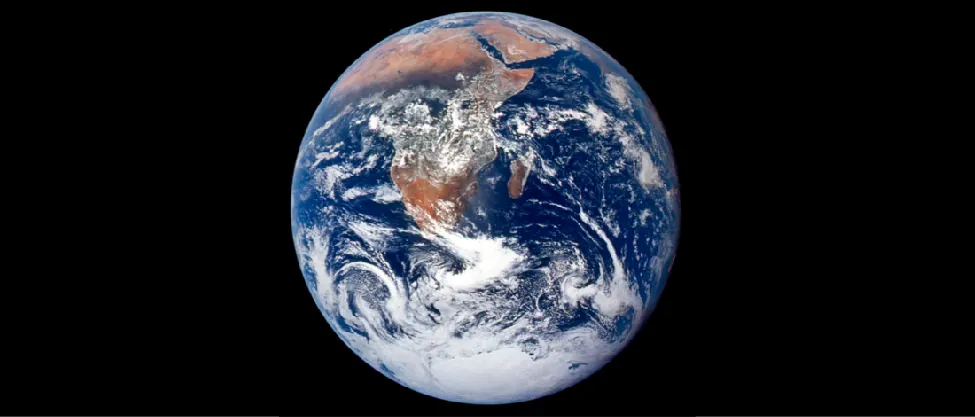
The full disk of Earth photographed by the Apollo 17 crew: Africa, the Arabian Peninsula and the Antarctic ice sheet visible against black space.
OpenStax Astronomy 2e, Figure 8.2 — credit: modification of work by NASA

Source: OpenStax Astronomy 2e, 8.1

Step 2 of 9

A planet you cannot open

Earth's radius is about 6,371 kilometers. The deepest hole anyone has ever drilled reaches about 12 kilometers. That is one five-hundredth of the way. Every claim you are about to read about the inside of this planet is indirect. Nobody has seen any of it.

Source: OpenStax Astronomy 2e, 8.1

Step 3 of 9

The clue is the weight

Weigh the whole planet, divide by its volume, and Earth averages about 5.5 grams per cubic centimeter. Now pick up a rock. Surface rock is about 3. The planet is roughly twice as dense as the material it is wrapped in. Something much heavier has to be down there.

Key words:

Source: OpenStax Astronomy 2e, 8.1

Step 4 of 9

How we look inside

Earthquakes send waves through the whole planet. The waves speed up, slow down and bend as they cross from one material into another, and some of them stop dead at a liquid. Detectors all over the world record when each wave arrives. From the pattern of arrivals — including the places where nothing arrives at all — the layers can be mapped. It is the same idea as an ultrasound scan.

Key words:

Source: OpenStax Astronomy 2e, 8.1

Step 5 of 9

What the waves found

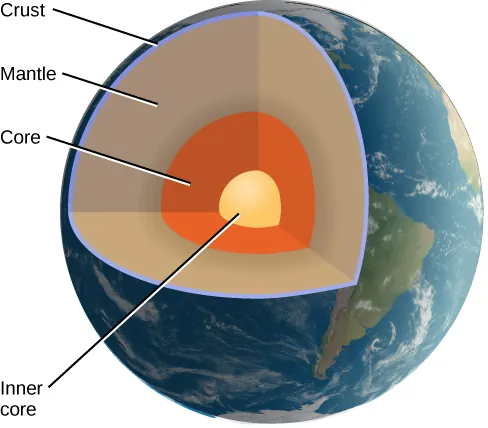
Four layers. The crust is the thin skin: about 6 km of basalt under the oceans, 20 to 70 km of granite under the continents, and only 0.3 percent of the planet's mass. The mantle is the huge solid middle, reaching down 2,900 km. Below that the outer core is liquid metal, and at the center sits a solid inner core about 2,400 km across. Take the metal core as a whole and it is about 7,000 km wide — substantially larger than the entire planet Mercury.

Cut-away diagram of Earth showing the thin crust, the thick mantle, the liquid outer core and the solid inner core, with depths marked.
OpenStax Astronomy 2e, Figure 8.3

Key words:

Source: OpenStax Astronomy 2e, 8.1

Step 6 of 9

How it got sorted

Early Earth was hot enough to be largely molten. In a molten planet, heavy material sinks and light material floats, exactly the way oil separates from water. Iron and nickel went to the center. Lighter rock rose to the top and became the crust. Scientists call this sorting differentiation, and it is why Earth has a metal core at all.

Key words:

Source: OpenStax Astronomy 2e, 8.1

Step 7 of 9

The machine in the middle

The outer core is liquid metal, and it is moving. Heat escaping from the core out into the mantle keeps it circulating, helped along by light material squeezed out as the inner core slowly freezes. Moving metal means moving electric charge, and moving electric charge generates a magnetic field. Earth's field is not a bar magnet buried in the middle. It is a process, and processes can stop.

Key words:

Source: OpenStax Astronomy 2e, 8.1

Step 8 of 9

What the field buys you

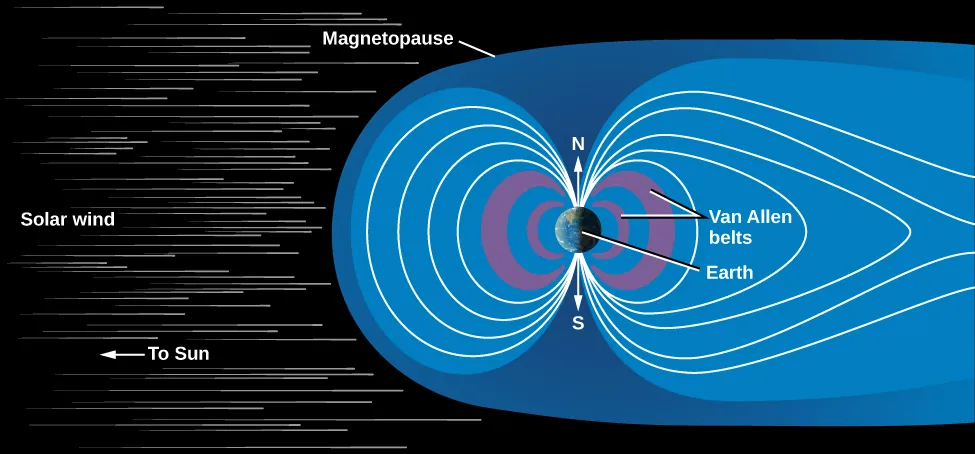
The Sun blows a constant stream of charged particles past us at hundreds of kilometers per second. Earth's magnetic field carves out a protected bubble in that stream, called the magnetosphere. It reaches roughly 60,000 km toward the Sun and is dragged out into a long tail on the night side. Particles that do get caught are held in the Van Allen belts, found by Explorer 1 in 1958 — the first discovery of the space age.

Cross-section of Earth's magnetosphere: field lines compressed on the side facing the solar wind and stretched into a long tail on the far side.
OpenStax Astronomy 2e, Figure 8.5

Key words:

Source: OpenStax Astronomy 2e, 8.1

Step 9 of 9

Now read Block 3 again

Block 3 tells you Mars is smaller, so its core cooled faster, so its magnetic field collapsed, so the solar wind stripped its air away. Until now that was a chain you had to take on trust. You now know what each link is made of. Your job: write the chain out in your own words, and mark the one link you would still want more evidence for.

Source: Links to Unit 1, Block 3

Earth's numbers

These are the Earth column of your Habitability Framework. Copy them; do not re-derive them. They come from one source, so your whole class is calibrated to the same baseline.

PropertyMeasurement
Distance from the Sun (semimajor axis)1.00 AU
Orbital period1.00 year
Mass5.98 × 1024 kg
Diameter12,756 km
Radius6,378 km
Escape velocity11.2 km/s
Rotation period23 h 56 m 4 s
Surface area5.1 × 108 km2
Density5.514 g/cm3
Atmospheric pressure at the surface1.00 bar (sea-level pressure is about 101 kPa)

OpenStax, Astronomy 2e, Table 8.1. The kilopascal figure is ours. One bar is exactly 100 kPa; Earth's actual sea-level pressure is about 101 kPa, which is the number the Block 3 comparison table uses. Astronomers round it to 1 bar and treat that as the planetary yardstick.

The air Earth kept

Nine steps from a planet with no breathable air to one whose atmosphere is visible evidence that something is alive on it. This is the Lovelock idea from Unit 0, told forwards.

Step 1 of 9

Not original equipment

The air you are breathing is not the air this planet started with. A small, warm planet cannot hold on to hydrogen or helium, so whatever Earth captured from the cloud it formed in leaked away early. What replaced it is less settled than you might expect. OpenStax lists three candidate sources — gas trapped as Earth built itself, gas released from the interior, and material delivered by comets and asteroids — and says the evidence currently favors the last two.

Key words:

Source: OpenStax Astronomy 2e, 8.3

Step 2 of 9

What it is now

Take the water out of a sample of air and it is 78 percent nitrogen, 21 percent oxygen and about 1 percent argon. Carbon dioxide is a trace, about 0.04 percent, and it matters far more than that number suggests. Water vapor is separate again, swinging from almost nothing to around 4 percent depending on where and when you measure. At sea level all of it together presses down at about 101 kilopascals. Astronomers write that as 1 bar.

Key words:

Source: OpenStax Astronomy 2e, 8.3

Step 3 of 9

Where the second air came from

Volcanoes. A hot young planet vents gas trapped inside it out through its crust, a process called outgassing. What came out was mostly carbon dioxide, nitrogen and water vapor. There was essentially no free oxygen in it. Nothing you know could have breathed it.

Key words:

Source: OpenStax Astronomy 2e, 8.3

Step 4 of 9

Where most of the carbon went

The water vapor cooled and rained out, and the oceans are what is left of that rain. Carbon dioxide dissolves in water, and dissolved carbon dioxide reacts with rock to make carbonate, which settles as sediment. So Earth's early carbon dioxide is not gone: most of it is in the limestone. Venus, with no oceans, kept its carbon dioxide in the air — and runs at about 460 degrees Celsius.

Key words:

Source: OpenStax Astronomy 2e, 8.3 and 8.4; Venus surface temperature from NASA

Step 5 of 9

Something starts living in it

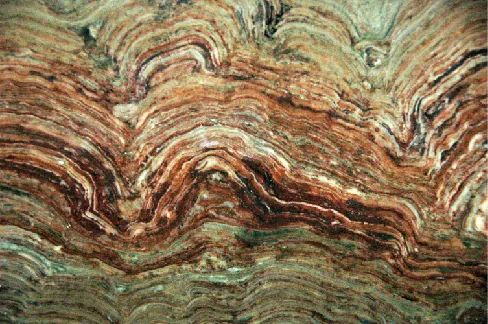
Life got going early, though exactly how early is contested. OpenStax puts life on Earth by about 3.9 billion years ago; that evidence is chemical rather than fossil, and other scientists have argued the same signals could be produced without life. The oldest evidence most people accept, and the oldest you can look at in a photograph, is stromatolites: layered mounds built by mats of microbes in shallow water, about 3.5 billion years old, and still forming in a few places today.

Polished cross-section through a fossil stromatolite showing stacked dome-shaped layers of trapped sediment.
OpenStax Astronomy 2e, Figure 8.15 — credit: James St. John

Key words:

Source: OpenStax Astronomy 2e, 8.4

Step 6 of 9

The waste product that changed the planet

Some of those microbes could photosynthesize: use sunlight to build sugar from carbon dioxide and water. Oxygen is what that reaction throws away. For a long time the oxygen was mopped up by rock and dissolved iron as fast as it was made. Then the sinks filled and free oxygen started building up in the air. OpenStax dates that to about 2 billion years ago; current geochemistry puts the start nearer 2.4 billion. Either way, the largest change in the history of Earth's atmosphere was pollution released by something living.

Key words:

Source: OpenStax Astronomy 2e, 8.4, with the more recent date noted

Step 7 of 9

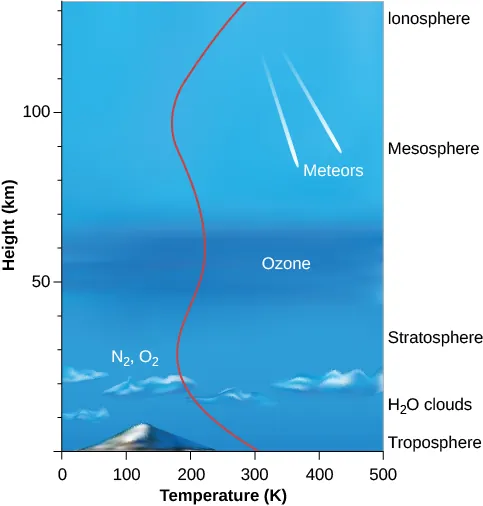
Oxygen builds a roof

High in the atmosphere, ultraviolet light splits oxygen molecules and the fragments re-form as ozone, a molecule of three oxygen atoms. Ozone absorbs the ultraviolet that would otherwise reach the ground and wreck the chemistry of anything living there. Only once that layer existed could life leave the water and move onto land. The shield is made out of the waste.

Diagram of the atmosphere's layers from troposphere to ionosphere. Height increases up the left-hand side, temperature runs along the bottom, and the ozone layer sits in the stratosphere.
OpenStax Astronomy 2e, Figure 8.12

Key words:

Source: OpenStax Astronomy 2e, 8.3 and 8.4

Step 8 of 9

So the air is the evidence

Earth's atmosphere holds 21 percent oxygen and a steady trace of methane at the same time. Those two react with each other. On a dead planet they would have finished reacting long ago and the mixture would have settled. They have not settled here, because living things keep making more of both. That is Lovelock's argument from Unit 0, arrived at from the other direction. The modern version is narrower and worth knowing precisely: Thompson and colleagues calculated that methane together with carbon dioxide, and very little carbon monoxide, would be the detectable sign of life on a TRAPPIST-1e resembling early Earth, and that the JWST could test for it in roughly 5 to 10 transits. Oxygen itself is the harder target, and they say so.

Key words:

Source: OpenStax Astronomy 2e, 8.4; Lovelock 1965; Thompson et al. 2022

Step 9 of 9

Now the part that is yours

Two questions to take into Block 7. First: which entries in Earth's column of your framework are causes of life, and which are consequences of it? Second: if you applied your framework to Earth as it was 3 billion years ago — no oxygen, no ozone, life definitely present — how many criteria would Earth fail? If the answer is any, your framework has a problem worth writing about.

Source: Links to Unit 1, Block 7

Three places where we do not follow the textbook

The greenhouse effect. OpenStax says it raises Earth's surface temperature by about 23 °C. Most other sources put it near 33 °C, comparing a calculated −18 °C with the observed +15 °C. Both are honest numbers from different baselines. This course uses the −18 °C to +15 °C comparison, because that is what the Block 3 table and Unit 4 are built on, and mixing the two leaves you defending a figure you cannot source. The mechanism itself is Unit 4's job, not this page's.

The Chicxulub impact. OpenStax dates it to 65 million years ago and says more than half of species died. The current figures are about 66 million years and roughly three quarters of species. The deck uses the current ones.

The rise of oxygen. OpenStax puts the build-up of free oxygen at about 2 billion years ago. Current geochemistry, working from sulfur isotopes, puts the start closer to 2.4 billion. Deck 2 gives you both.

None of this makes OpenStax a bad source. It makes it a source, which is the whole point of OPVL: a textbook is written once and the science keeps moving. You cite what you used, you notice where it disagrees with something else, and you say which one you went with and why. If you can do that on this page, you can do it on your exoplanet.

Extension Not required. Worth it: it ends with a Limitation you can put straight into your report.

The factor nobody lists

Seven steps on the habitability factor that almost never makes it onto the Block 1 board. Extension: not required, but it ends with a Limitation you can use.

Step 1 of 7

Check your Block 1 list

Distance from the star. Liquid water. An atmosphere. A magnetic field. The right size. Every class produces roughly that list. Almost nobody writes down "does not get hit very often", and yet the history of life on this planet has been rewritten by objects arriving from space.

Source: OpenStax Astronomy 2e, 8.5

Step 2 of 7

So where are our craters?

The Moon is saturated with impact craters. Earth, a bigger target in the same neighborhood, shows almost none. Earth is not being missed. Earth erases. Crust is recycled at plate boundaries, rain and rivers grind the surface down, and oceans and vegetation cover what is left. The Moon has none of those, so it keeps its receipts.

Key words:

Source: OpenStax Astronomy 2e, 8.2 and 8.5

Step 3 of 7

One that survived

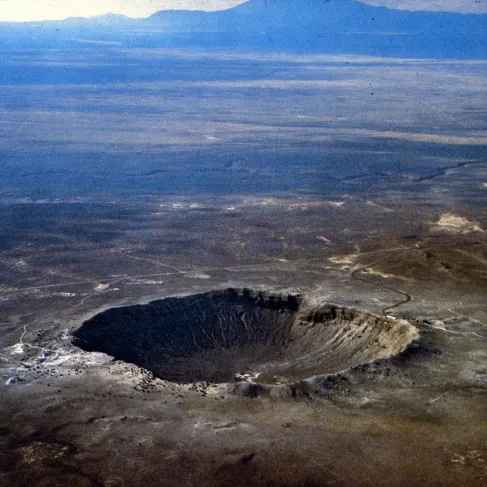
Meteor Crater in Arizona is about 1.2 km across and about 50,000 years old. The object that made it was a lump of iron roughly 40 meters wide. It is well preserved for one reason: it sits in a desert, where there is little water to wear it away.

Aerial photograph of Meteor Crater, Arizona: a circular bowl with a raised rim standing in flat desert.
OpenStax Astronomy 2e, Figure 8.21 — modification of work by D. Roddy/USGS

Source: OpenStax Astronomy 2e, 8.5

Step 4 of 7

One that never landed

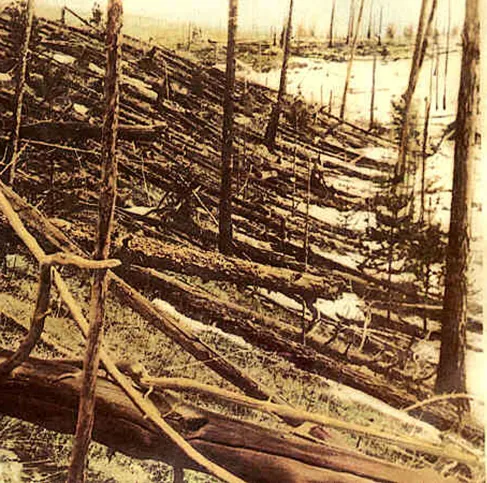
In 1908 an object came in over Tunguska in Siberia and exploded in the air. It flattened forest across more than 2,000 square kilometers and left no crater, because it never reached the ground. How big and how energetic is still argued over: OpenStax says about 10 megatons, later modeling of the air-burst gets down to 3 to 5, and the estimated size of the object moves with the model, somewhere between about 30 and 60 meters. An atmosphere is a shield as well as a blanket.

Photograph taken 19 years after the Tunguska explosion showing a forest of trees snapped off and lying flattened in one direction.
OpenStax Astronomy 2e, Figure 8.20 — modification of work by Leonid Kulik

Source: OpenStax Astronomy 2e, 8.5, with the range from later modeling

Step 5 of 7

The one that changed everything

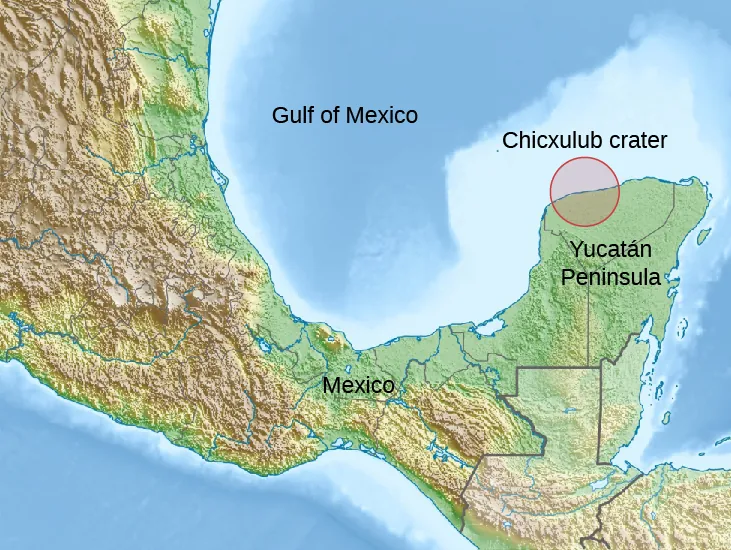
About 66 million years ago an object roughly 10 km across struck what is now the Yucatán peninsula in Mexico. The impact threw enough material into the atmosphere to darken the sky, started fires, and acidified the rain. Around three quarters of species on Earth died, including every dinosaur that was not a bird. The crater is still there, buried under about a kilometer of younger sediment.

Map of the Yucatán peninsula in Mexico with the buried Chicxulub crater outlined off the northern coast.
OpenStax Astronomy 2e, Figure 8.22 — modification of work by "Carport"/Wikimedia

Key words:

Source: OpenStax Astronomy 2e, 8.5, with the current date and species estimate

Step 6 of 7

How that was worked out

Nobody went looking for a crater. In 1980 a team reported that a thin clay layer laid down at exactly the extinction boundary — measured at sites in Italy, Denmark and New Zealand — was unusually rich in iridium, a metal rare in Earth's crust and common in asteroids. From that they predicted a large impact. Here is the part worth sitting with: a buried circular structure under the Yucatán had already been mapped by oil-company geophysicists in 1978, and nobody had read it as a crater. It was recognized as one in 1991, in the place and of the age the prediction required. The evidence was on the shelf before anyone knew what question it answered.

Key words:

Source: OpenStax Astronomy 2e, 8.5, with the discovery history

Step 7 of 7

Now the part that is yours

Impacts are a real habitability variable, and here is the uncomfortable part: for your exoplanet you can barely measure it. You have no impact history at all. And the tidy idea that a big outer planet acts as a shield turns out to be contested — some modeling finds a giant planet can raise the impact rate on an inner world rather than lower it. Write that into the Limitations section of your Goldilocks Report, in your own words, and say what you would need to observe to do better than a guess.

Key words:

Source: Links to the Goldilocks Report

Word list

All 34 words from the three decks, in the order they come up. Every one of them is also defined in place inside the slides; this list is for revising.

  • density noun

    How much mass is packed into a given amount of space. Two rocks the same size can have very different densities.

    The whole argument for Earth having a metal core starts here: the planet as a whole is denser than the rock on its surface.

  • seismic wave noun

    A wave of energy that travels through the Earth, usually made by an earthquake.

    Seismic waves are the only tool we have for looking inside the planet. Everything in deck 1 rests on them.

  • shadow zone noun

    A region of Earth's surface where a particular kind of seismic wave never arrives after an earthquake.

    A place where nothing arrives is evidence. The shadow zone is how the liquid outer core was found.

  • crust noun

    The thin outer rock layer of a planet. On Earth it is a few kilometers thick under the oceans and much thicker under the continents.

    Only 0.3 percent of Earth's mass, and the only part anyone has ever sampled directly.

  • mantle noun

    The thick rock layer between a planet's crust and its core. On Earth it reaches down about 2,900 km.

    Solid, but it can deform slowly under pressure, which is what lets it move over long periods.

  • core noun

    The dense metal center of a planet. Earth's has a liquid outer part and a solid inner part.

    Mostly iron and nickel. The liquid outer part is what generates the magnetic field.

  • basalt noun

    A dark, dense volcanic rock. It makes up most of the ocean floor.

  • granite noun

    A lighter-colored, less dense rock. It makes up most of the continents.

    Continents float higher than ocean floor because granite is less dense than basalt.

  • differentiation noun

    The sorting of a planet's material by density while the planet is molten: heavy material sinks to the middle, light material rises to the top.

    A planet has to be hot enough to be liquid for this to happen. A planet that never melted would be the same all the way through.

  • dynamo noun

    A process that generates a magnetic field from moving, electrically conducting fluid. In a planet, that fluid is liquid metal in the core.

    Say "process", not "thing". A dynamo needs the motion to continue; if the core stops circulating, the field goes away.

  • magnetic field noun

    The region of magnetic influence around a magnet or a planet, and the strength and direction of that influence at each point.

  • magnetosphere noun

    The region around a planet where the planet's own magnetic field is stronger than the magnetic field carried by the solar wind.

    Earth's reaches about 60,000 km on the day side and is stretched into a long tail on the night side.

  • solar wind noun

    The constant stream of charged particles blowing outward from the Sun in all directions.

    This is what stripped Mars. It is the thing a magnetosphere protects you from.

  • Van Allen belts noun

    Two zones of high-energy charged particles trapped inside Earth's magnetic field.

    Found by Explorer 1 in 1958, the first American satellite. Named for the scientist whose instrument detected them.

  • primary atmosphere noun

    The first atmosphere a planet has, made of the light gases it captured from the cloud it formed in: mostly hydrogen and helium.

    Earth lost its primary atmosphere. Jupiter kept its own, because it is far more massive and far colder.

  • secondary atmosphere noun

    The replacement atmosphere a planet builds from gas released out of its own interior.

    Earth's second atmosphere came out of volcanoes. Our current one is arguably a third, because life rebuilt it.

  • outgassing noun

    The release of gas that was trapped inside a planet's rock out to its surface, mostly through volcanoes.

  • bar noun

    A unit of pressure, defined as exactly 100 kilopascals. It was chosen because it is close to the pressure of Earth's atmosphere at sea level.

    Close to, not equal to. Earth's actual sea-level pressure is about 101 kPa, so about 1.01 bar. Astronomers round it to 1 bar and use that as the planetary yardstick.

  • kilopascal noun

    A metric unit of pressure, written kPa. Earth's sea-level air pressure is about 101 kPa.

    1 bar = 100 kPa exactly. Pick one unit for your framework column and stay in it; do not convert halfway down the table.

  • carbonate noun

    A mineral that contains carbon and oxygen bonded together, formed when dissolved carbon dioxide reacts with rock. Limestone is made of it.

    Most of the carbon dioxide Earth's volcanoes released is now locked in carbonate rock, not in the air.

  • stromatolite noun

    A layered mound built up in shallow water by mats of microbes trapping sediment.

    Among the oldest fossil evidence of life on Earth, and the oldest you can look at in a photograph. The well-accepted ones are about 3.5 billion years old.

  • microbe noun

    A living thing too small to see without a microscope, such as a bacterium.

    For most of Earth's history, microbes were the only life there was.

  • photosynthesis noun

    The process by which some living things use sunlight to build sugar out of carbon dioxide and water, releasing oxygen as waste.

    The oxygen in the air you are breathing is a waste product. That framing is worth sitting with.

  • cyanobacteria noun

    A group of bacteria that can photosynthesize. Older texts call them blue-green algae, but they are not algae.

    OpenStax uses the older name. The organism is the same.

  • ozone noun

    A molecule made of three oxygen atoms, written O3. It forms high in the atmosphere and absorbs ultraviolet light.

    Ordinary oxygen is O2. Ozone is a different molecule with different behavior.

  • ultraviolet noun

    Light with more energy than the violet end of the visible range. You cannot see it, and it damages living tissue.

    Often shortened to UV.

  • disequilibrium noun

    A state that has not settled down: gases that should have finished reacting with each other are still both present.

    Lovelock's whole 1965 argument, from Unit 0 Block 2. Disequilibrium needs something to keep maintaining it.

  • biosignature noun

    Something you can measure about a planet that would be hard to explain unless something living were there.

    The oxygen-and-methane pair is the standard example. It is Hitchcock and Lovelock's, from 1967, two years after the paper you read in Unit 0. A biosignature is a strong hint, never a proof.

  • impact crater noun

    A bowl-shaped hollow left where an object from space struck a planet or moon.

  • erosion noun

    The wearing away and carrying off of rock and soil by water, ice, wind, or gravity.

    Unit 2 is built on this. Here it matters because it is one of the reasons Earth has so few visible craters.

  • plate tectonics noun

    The slow movement of the large sections that Earth's crust is broken into, driven by motion in the mantle below.

    Unit 3 covers this properly. Here you only need one consequence: crust gets recycled, so old surfaces do not survive.

  • iridium noun

    A dense metal that is rare in Earth's crust but common in asteroids.

    Finding a lot of it in a thin worldwide clay layer is what made scientists predict a large impact before the crater was found.

  • mass extinction noun

    An event in which a large share of the species alive on Earth die out in a short period of geological time.

  • near-Earth object noun

    An asteroid or comet whose orbit brings it close to Earth's orbit.

    Often shortened to NEO. Surveys track them; the DART mission tested whether one could be pushed off course.

Sources

Full course source library →

This page adapts material from OpenStax, Astronomy 2e (sections 8.1, 8.3, 8.4 and 8.5), © OpenStax, Rice University, used under a Creative Commons Attribution-NonCommercial-ShareAlike 4.0 International license. Access the book for free at https://openstax.org/books/astronomy-2e/pages/1-introduction.

The slide text on this page is our own adaptation of that material and is released under the same CC BY-NC-SA 4.0 license. The figures are reproduced from OpenStax and keep their original credit lines. This notice covers this page; the rest of the site is not affected.

Done here? Back to the lesson: ← Unit 1 · Block 2← Unit 1 · Block 3