Block 1: Weathering: How Rocks Break Down
Two satellite views of Pallikaranai Marsh, thirty years apart: 1988 (vast marsh extending much further) and 2018 (heavily encroached).
Task: What changed? What forces (natural and human) caused that change? What story does this place tell?
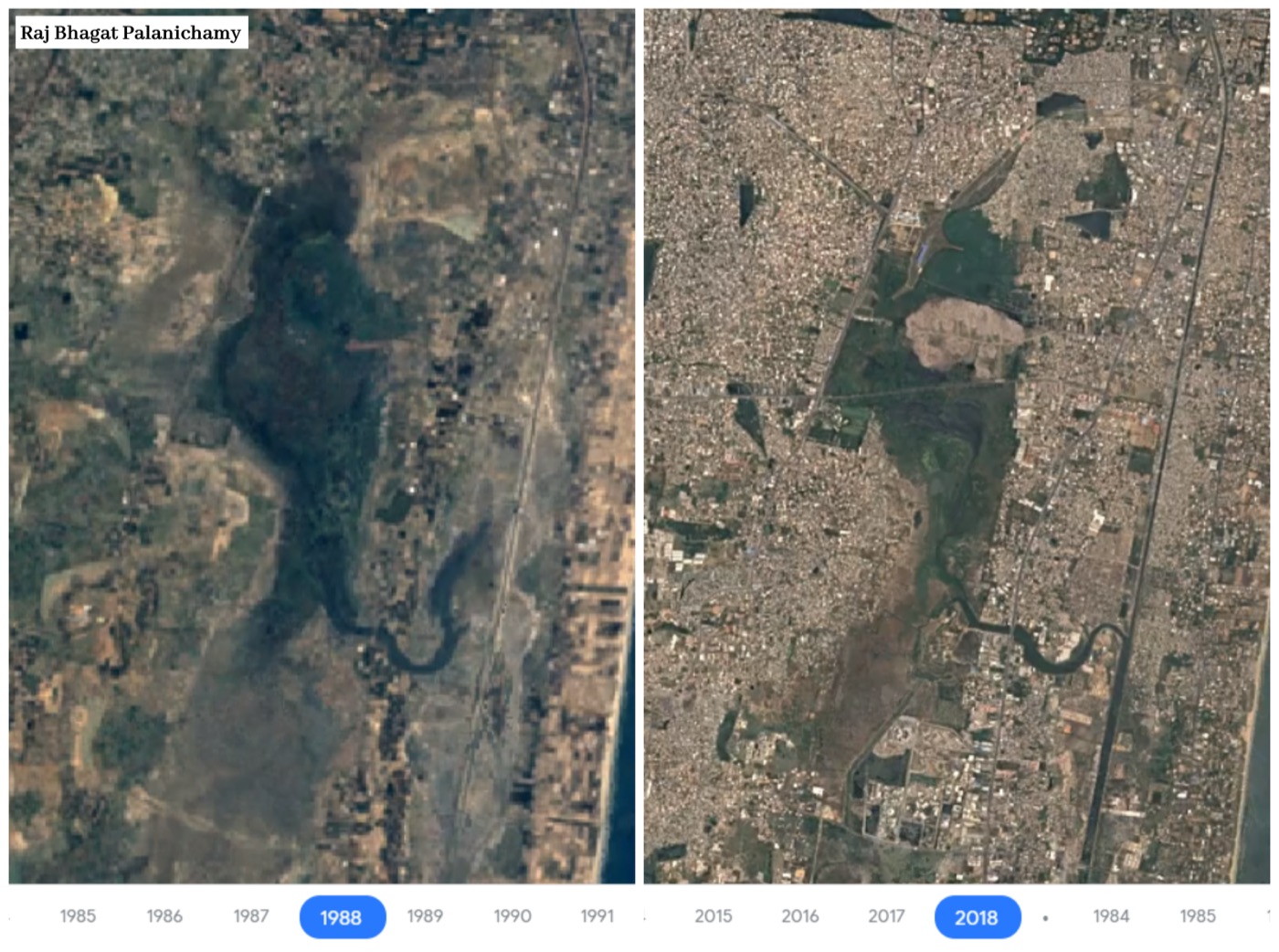
Answer in your Field Notebook, dated.
I can identify mechanical and chemical weathering processes in field photos, distinguish them from erosion, and name a specific weathering process happening at AISC.
I can explain how Earth's surface features are built and reshaped by processes working at very different speeds and sizes.
"Develop a model to illustrate how Earth's internal and surface processes operate at different spatial and temporal scales to form continental and ocean-floor features."
Where this runs:
- U2 B1: Weathering: How Rocks Break Down ← you are here
- U2 B2: Erosion: How Earth Moves Itself Around
- U2 B6: Field Photo / Map Analysis Work Day
- U2 B7: Reading the Landscape: Worked Example + OPVL
- U3 B1: Inside Earth + Boundary Types
- U3 B2: Subduction & Transform Deep Dive + Sim Demo
Assessed:
Landscape Reading: biography past + current processes (K/U strand, Components 1–2 lock U2 Block 6)
On track looks like:
Your location's biography names specific processes at specific timescales ('monsoon pulses move the beach yearly; the harbour changed it in decades'), not just 'erosion happened.'
The Field Geologist · Pallikaranai worked example (in Google Classroom)
I ask what keeps a system steady, and what tips it into change.
In brief: "Systems can be stable or change over time; feedback and rates of change determine which."
Where this runs:
- U1 B2: Earth as Baseline: Systems Thinking + Subsystems
- U1 B2.5: Earth Systems, Second Pass: One Step at a Time
- U1 B3: Mars as Calibration: What Does Earth Have That Mars Doesn't?
- U1 B7: Habitability Framework: Building the Comparison
- U2 B1: Weathering: How Rocks Break Down ← you are here
- U2 B2: Erosion: How Earth Moves Itself Around
- U2 B6: Field Photo / Map Analysis Work Day
- U2 B7: Reading the Landscape: Worked Example + OPVL
- U3 B1: Inside Earth + Boundary Types
- U3 B2: Subduction & Transform Deep Dive + Sim Demo
- U4 B5: IPCC AR6 Deep Dive + Chennai Climate Brief Assigned
- U4 B6: Climate Models: How They Work, How They're Wrong, How to Read Them
- U4 B7: Regional Climate Change: From Global Average to Chennai's Monsoon
What today is about
The first process. Everything else in the unit follows from this one.
Weathering is the rock-breaking step: before anything moves (erosion) and before anything settles (deposition), rocks have to come apart. Mechanical weathering (frost wedging, root prying, thermal stress) breaks rock physically; chemical weathering (dissolution, oxidation, hydrolysis) changes the rock chemically. In tropical Chennai, chemical weathering dominates: deep, persistent, humid conditions break rock down through chemistry more than through physics.
Today's anchor question ("what stories does the landscape tell us?") is the question driving the whole unit. Today we start with the smallest story: how a single rock breaks. By Block 9 you'll be telling the biography of an entire Chennai location.
This unit also introduces the Field Geologist, an AI partner that knows the nine Landscape Biography locations and thinks like someone standing at your site with a notebook. It asks what you observed before it discusses what anything means. Read its opening message on the partner page before your first conversation.
Before you start the work
Start with the Watch: projected for everyone. The Interact is a quick warm-up that follows it, and the Read is your reference for the photo-ID work. Notes go in your Class Notebook as a Power outline.
Help if you want it Taking notes? Power 1 seeds for today
Everyone does this
Today's work: choose one path
All four paths end the same way: a labeled photo set or photo response that identifies specific weathering processes. The path you pick is about where you do the work.
Sketch first, no words (5 min, alone): one drawing that shows the DIFFERENCE between weathering and erosion. Compare with a partner (3 min): can they tell which side is which without you explaining? Note it in your Field Notebook, dated; today's work sharpens exactly this distinction.
Open your Class Notebook and type today's entry header as Heading 2:
A: Oct 21 | U2 B1 | Weathering: How Rocks Break DownB: Oct 27 | U2 B1 | Weathering: How Rocks Break Down
What you're submitting today
Whichever path you chose, the artifact is the same shape: weathering processes named, with evidence.
Name one specific weathering process happening on AISC's own grounds. Describe what you'd see if you went to look at it. One sentence is fine; the point is specificity, not length. "Chemical weathering" is too generic. "Iron oxidation rusting the metal railing by the science block back door" is the move.
Submit via Google Classroom (link posted in August)One question before you leave
Three to five minutes. Your answer is saved to your reflection journal, where you can read back everything you have written this year.
The reflection style this block is the unit-opening "I used to think... now I think..." move.
Today's reflection is in Google Classroom, under Reflection Journal.
Link posted in AugustSign in with your school account. Your teacher can see what you write here.