Block 2: Earth as Baseline: Systems Thinking + Subsystems
From last class: what factors did you list as making a planet habitable? Add one more factor now that you've slept on it.
Task: Share with a partner.
Answer in your Field Notebook, dated.
I can name Earth's four subsystems (atmosphere, hydrosphere, geosphere, biosphere) and give a concrete example of how two of them interact.
I can show how one change on Earth sets off feedback loops that change other Earth systems.
"Analyze geoscience data to make the claim that one change to Earth's surface can create feedbacks that cause changes to other Earth systems."
Where this runs:
- U1 B2: Earth as Baseline: Systems Thinking + Subsystems ← you are here
- U1 B2.5: Earth Systems, Second Pass: One Step at a Time
- U1 B3: Mars as Calibration: What Does Earth Have That Mars Doesn't?
- U1 B7: Habitability Framework: Building the Comparison
Assessed:
Goldilocks Report: framework criteria with feedback reasoning, esp. field 5 'where it can fail' (K/U, Component 1 locks U1 Block 7)
On track looks like:
You can run the perturbation test on a loop and say whether it amplifies or stabilizes, and your framework uses that move on real criteria.
Feedback Loops handout (in Google Classroom) · The Systems Diagrammer · Reading: Four Spheres, One System
I can model what is inside Earth, and explain how heat moving through it drives what happens on the surface.
"Develop a model based on evidence of Earth's interior to describe the cycling of matter by thermal convection."
Where this runs:
- U1 B2: Earth as Baseline: Systems Thinking + Subsystems ← you are here
- U1 B2.5: Earth Systems, Second Pass: One Step at a Time
- U1 B3: Mars as Calibration: What Does Earth Have That Mars Doesn't?
Assessed:
Goldilocks Report: the geosphere and magnetic-field criteria (K/U, Component 1 locks U1 Block 7)
On track looks like:
You can say what each layer is, how we know it is there without anyone having been down, and why a liquid moving core is what produces a magnetic field.
I ask what keeps a system steady, and what tips it into change.
In brief: "Systems can be stable or change over time; feedback and rates of change determine which."
Where this runs:
- U1 B2: Earth as Baseline: Systems Thinking + Subsystems ← you are here
- U1 B2.5: Earth Systems, Second Pass: One Step at a Time
- U1 B3: Mars as Calibration: What Does Earth Have That Mars Doesn't?
- U1 B7: Habitability Framework: Building the Comparison
- U2 B1: Weathering: How Rocks Break Down
- U2 B2: Erosion: How Earth Moves Itself Around
- U2 B6: Field Photo / Map Analysis Work Day
- U2 B7: Reading the Landscape: Worked Example + OPVL
- U3 B1: Inside Earth + Boundary Types
- U3 B2: Subduction & Transform Deep Dive + Sim Demo
- U4 B5: IPCC AR6 Deep Dive + Chennai Climate Brief Assigned
- U4 B6: Climate Models: How They Work, How They're Wrong, How to Read Them
- U4 B7: Regional Climate Change: From Global Average to Chennai's Monsoon
I follow where energy and matter go; neither appears from nowhere.
In brief: "Tracking energy and matter into, out of and within a system shows what the system can and cannot do."
Where this runs:
- U1 B1: Phenomenon Launch: What Makes a Planet Habitable?
- U1 B2: Earth as Baseline: Systems Thinking + Subsystems ← you are here
- U1 B2.5: Earth Systems, Second Pass: One Step at a Time
- U1 B3: Mars as Calibration: What Does Earth Have That Mars Doesn't?
- U1 B4: Habitable Zone, AU, Light-year: Scale of the Cosmos
- U4 B3: The Carbon Cycle: Fast + Slow
- U4 B4: Human Acceleration of Carbon + The Warming Signal
What today is about
Last class: a list of factors. Today: a system.
In Block 1 you listed five-plus factors that might affect whether a planet can support life. Today we make the move that the rest of this course depends on: those factors don't sit alone. They interact. A magnetic field protects an atmosphere. An atmosphere holds heat and shapes water cycles. Water shapes weather, weather shapes rocks, rocks shape carbon storage. Earth's habitability isn't a checklist; it's a system.
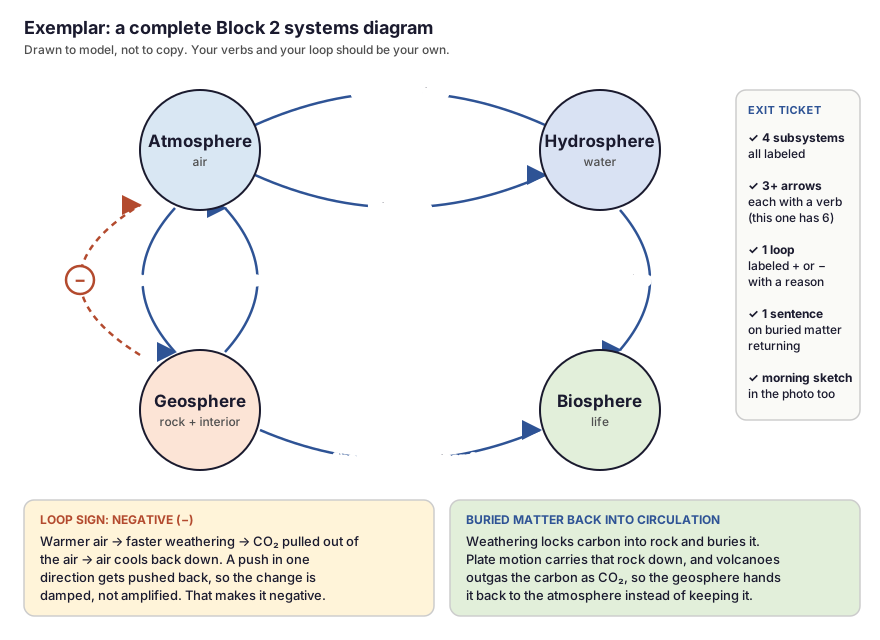
The right unit of analysis from here on is Earth's four subsystems: the atmosphere (air), hydrosphere (water), geosphere (rock + interior), and biosphere (life). Each one interacts with the others through energy flows and matter cycles, and many of those interactions are feedback loops: relationships that either amplify a change (positive feedback) or push back toward stability (negative feedback). Systems thinking is the lens you'll use for every unit after this one too: weather, plate tectonics, hydrology, ecology, energy, sustainability. It all comes back to this move.
The Systems Diagrammer AI partner launches today. It's live: open it from today's Google Classroom post, where both links are posted (Flint for two sections, BoodleBox for one). Use your class's link. It's a coach, not a drawing tool; it asks you the questions you'd ask yourself if you had more practice. The goal is that by exit ticket you have a defensible first systems diagram, drawn by you.
You'll draw twice today: once your way, once the shared way. The difference between those two drawings is the point.
Before you start the work
Keep this open. The handout is provided in class and is the reference for today's diagram work. Notes go in your Class Notebook as a Power outline.
Help if you want it Taking notes? Power 1 seeds for today
Everyone does this
Today's work: choose one path
Three real paths. All three end at the same exit ticket: a defensible first systems diagram of Earth.
Before the convention, your picture. Five minutes, alone: draw how Earth's parts connect: your way, pictures only, no words. Then three minutes with a partner: where do your drawings agree? Keep the sketch in your Field Notebook, dated. Now, the choice board below teaches the shared way scientists draw this, and you'll feel why the conventions exist: you just hit every problem they solve.
- On blank paper, draw the four subsystems as labeled circles.
- Draw at least three arrows between them, with a verb on each arrow ("evaporates," "weathers," "absorbs").
- Pick one loop in your diagram and label it positive (+) or negative (−).
- Under the diagram, write one sentence justifying that sign.
- With a partner, pick one specific interaction; ocean ↔ atmosphere is a strong starter.
- Talk it through out loud: what flows from A to B, what flows back, and what would happen if you removed one direction.
- Each of you draws that interaction on your own paper, then compare the two drawings.
- On your own, grow your drawing into the full diagram: all four subsystems, three arrows with verbs, one loop labeled + or −.
- Open the Systems Diagrammer from today's Google Classroom post (Flint or BoodleBox, whichever your class uses).
- Tell it you're new to systems diagrams and you want to build your first Earth one.
- Answer its questions: name one subsystem, then another, then an interaction. Draw on paper as you go; the partner stays Socratic and will not draw for you.
- Finish by asking it to check the sign of one feedback loop, then log the conversation in your AI Documentation.
Open your Class Notebook and type today's entry header as Heading 2:
A: Sep 7 | U1 B2 | Earth as Baseline: Systems Thinking + SubsystemsB: Sep 8 | U1 B2 | Earth as Baseline: Systems Thinking + Subsystems
What you're submitting today
First systems diagram of the year. Formative: scored as practice, not summative. Maps to T/T Thinking.
Your systems diagram, plus one sentence on what puts buried matter back into circulation. Feedback only, no band. It is practice for the thinking that Block 7 gets graded on.
A photo or scan of your systems diagram. Must include all four subsystems labeled, at least three interaction arrows with verbs, one feedback loop labeled + or − with a one-sentence justification, and one sentence on what puts buried matter back into circulation. Worth doing: put your morning sketch next to the diagram in the photo; the distance between the two drawings is today's learning, visible.
Submit via Google Classroom (link posted in August)One question before you leave
Three to five minutes. Your answer is saved to your reflection journal, where you can read back everything you have written this year.
Self-assessment against today's success criteria.
Today's reflection is in Google Classroom, under Reflection Journal.
Link posted in AugustSign in with your school account. Your teacher can see what you write here.