Block 1: Welcome + How We Work
Handout on your desk: Two texts, one topic. Both answer the same question, why does a growing city flood more.
Task: Read both, then answer Part 1 on the handout. For each text, decide whether it was written by a person or with AI, name the specific sentence or feature that made you decide, and say how sure you are about each one. Four minutes, on your own, no talking yet. Write on the handout: your Class Notebook does not exist until later today. Stop at the bottom of Part 1. Do not turn the page until you are told.
I can name the four OPVL letters and what each asks of a source.
I can find sources, judge them with OPVL, and communicate what I learned honestly.
"Obtaining, Evaluating, and Communicating Information"
Where this runs:
- U0 B1: Welcome + How We Work ← you are here
- U0 B2: OPVL Across Source Types
- U0 B3: AI as a Source + Documentation Protocol
- U0 B4: Source Dossier Launch + Choosing Your Topic
- U0 B5: Source Dossier Work Day 2: AI Source + Documentation
- U2 B9: Landscape Readings Submitted + Class Share-out
Assessed:
Source Dossier (all strands) + every OPVL component after it
On track looks like:
Your Limitations are specific to the source in front of you, never 'it might be biased.'
I can check an AI's answer against real sources and decide: use it, fix it, or bin it.
In brief: "Evaluate whether an AI output should be accepted, revised, or rejected (paraphrased; full framework at ailiteracyframework.org)"
Where this runs:
- U0 B1: Welcome + How We Work ← you are here
- U0 B2: OPVL Across Source Types
- U0 B3: AI as a Source + Documentation Protocol
- U0 B4: Source Dossier Launch + Choosing Your Topic
- U0 B5: Source Dossier Work Day 2: AI Source + Documentation
- U1 B1: Phenomenon Launch: What Makes a Planet Habitable?
- U1 B3: Mars as Calibration: What Does Earth Have That Mars Doesn't?
- U1 B5: Exoplanet Detection: Transits and What They Tell Us
- U1 B6: Reading Exoplanet Data Cards: Choosing Your Planet
- U1 B7: Habitability Framework: Building the Comparison
- U2 B3: Rivers as Landscape Sculptors
- U2 B6: Field Photo / Map Analysis Work Day
- U2 B7: Reading the Landscape: Worked Example + OPVL
- U4 B5: IPCC AR6 Deep Dive + Chennai Climate Brief Assigned
- U4 B6: Climate Models: How They Work, How They're Wrong, How to Read Them
Assessed:
Every AI Documentation Template: the 'one thing the AI got wrong' field
On track looks like:
You catch specific errors ('it said 2024; the report says 2023'), and you've stopped writing 'AI can hallucinate.'
I can estimate what my AI use costs in electricity and water, and decide when it's worth it.
In brief: "Understand how AI systems consume energy and natural resources (paraphrased)"
Where this runs:
- U0 B1: Welcome + How We Work ← you are here
- U4 B4: Human Acceleration of Carbon + The Warming Signal
Assessed:
U4: the Footprint Decision task
On track looks like:
You can put rough numbers on an AI choice and name one limitation of your own estimate.
What today is about
Two questions run this course: one for the whole year, one for this unit.
The year's question is How do you live well on a changing Earth? Every unit comes back to it. This unit's question is How do scientists know what they know, and how should we know what we know? For the next seven blocks, that is the one doing the work.
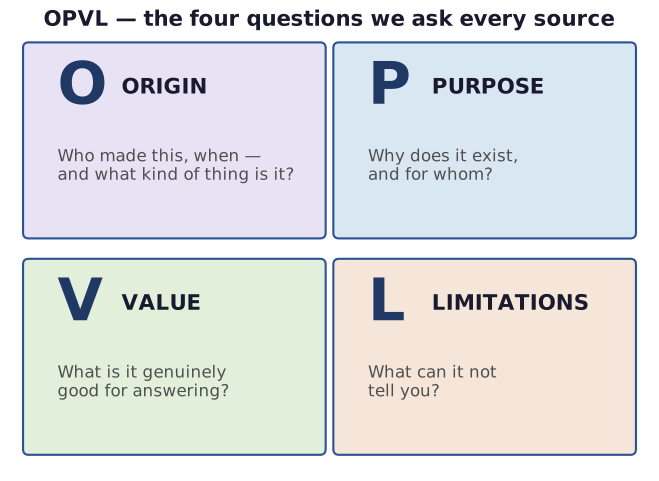
The anchor skill for the whole year is OPVL: Origin, Purpose, Value, Limitations. It's the framework you'll apply to every paper, news article, government report, and AI output we touch this year. We learn it here first, and we come back to it in every later unit at increasing difficulty.
Everything in this class is a routine you'll meet again. The full list lives at How This Class Works.
Before you start the work
Use all of these. Today's material is foundational, so nothing here substitutes for anything else; take them in whatever order class time allows. Notes go in your Field Notebook today and move into your Class Notebook once you set it up later this block; from Block 2 on, Power Notes go straight into the Doc.
Help if you want it Taking notes? Power 1 seeds for today
Everyone does this
Not a list to memorise. Each of these has a moment in today's block where you will actually meet it, and that moment is named so you can catch it when it arrives.
- source: anything you get information from. A paper, a news article, a person, a photograph, an AI.
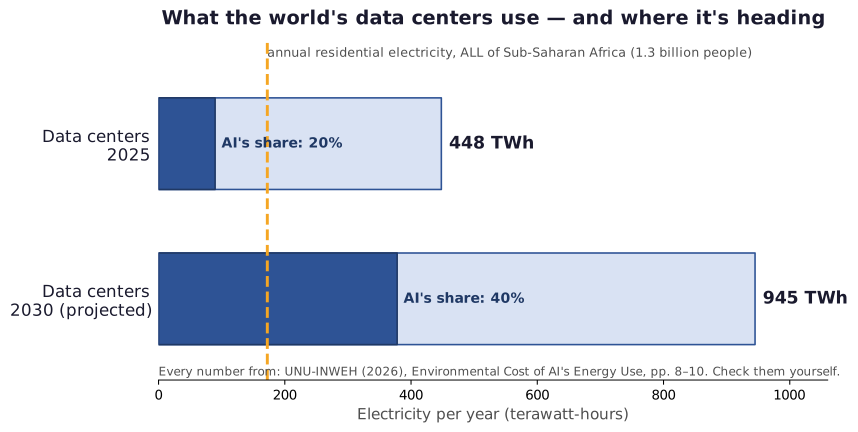
Today: all of it. You will judge four different sources before you leave. - primary source: original evidence, made at the time by the people who were there or who did the measuring.
Today: the UNU report. It holds the actual numbers. - secondary source: someone else's summary or interpretation of primary sources.
Today: the AP article. It reports on the UNU report, so you are reading about the numbers rather than reading the numbers. - OPVL: the four questions this course asks of every source. Origin, Purpose, Value, Limitations.
Today: the whole-class work on the AP article, and the exit ticket asks you to name all four. - bias: a leaning that shapes how a source presents information. Every source has some, so the useful question is which way it leans and how much.
Today: the AP article quotes industry voices saying the cost is worth it. Careful, "it might be biased" on its own is not a Limitation. Which way, and because of what? - disclosure (AI): telling your reader how and where you used AI.
Today: the handout on your desk. One of those two texts came with a disclosure statement and one did not.
- Now, in your Field Notebook, two minutes. Write the six words down the margin. Next to each, one line: what you think it means. Guess. Nobody collects this and being wrong now is the point.
- During the block. When a word turns up, tick it. If what it turned out to mean was different from your guess, star it instead. The stars are the ones worth keeping.
- Once your Class Notebook exists, later this block. These six words are your first entry, written as Power Notes under today's entry header.
Power Notes work for vocabulary because the shape already fits: the word is a Power 1, the meaning in your own words is a Power 2 (a Power 2 is a definition), and where you met it is a Power 3 (a detail underneath). So this entry is you rehearsing the format on six words you already met, before Block 2 asks you to use it on a research paper.
One rule for the Power 2 line: it has to be in your own words. If it matches the handout word for word you have copied, not learned. The Power 3 line is the one that shows you were actually here today.
Today's work: first OPVL together
Teacher-led whole-class activity. No choice board today. We do this together first, so you can hear what the thinking sounds like before you try it alone.
Straight on from the bell ringer, with the handout still in front of you.
- With a partner: did you mark them the same way? Where you disagree, whose evidence is harder to argue with, and why?
- Between you, list every feature you believe is a reliable sign that a human wrote something. Be specific. "It sounds natural" is not a feature.
- Stop there. We put the tallies and your lists on the board together before anyone turns a page.
- On the cue, Part 2. You get the second sheet then: read what each author said about AI use, answer the three questions, then stop again.
- On the second cue, Part 3.
The question we land on together, and the one Part 3 asks: when you cannot tell by reading, what is left?
You have two notebooks and they do different jobs. Ms. Jayanthi/Mr. Matt handed you the paper Field Notebook at the start of class: put your name on the front, and it takes your bell ringers and your sketches from here on. The Class Notebook is a Google Doc you make once, today, and it takes your Power Notes and the header line that indexes the year.
Set the Doc up now, following the setup steps at Your Two Notebooks: name it, share it once, turn the outline on, and add the linked table of contents. Then write today's first entry under the header line printed at the end of this section.
Open your Class Notebook and type today's entry header as Heading 2:
A: Aug 10 | U0 B1 | Welcome + How We WorkB: Aug 11 | U0 B1 | Welcome + How We Work
What you're submitting today
Exit ticket: quick and formative. Not part of the Source Dossier grade yet.
Name one OPVL letter you feel confident about after today's discussion, and one you want to practice more. Two sentences.
Submit via Google Classroom (link posted in August)One question before you leave
Three to five minutes. Your answer is saved to your reflection journal, where you can read back everything you have written this year.
No grade. Save it; we'll come back to this source in Block 4.
Today's reflection is in Google Classroom, under Reflection Journal.
Link posted in AugustSign in with your school account. Your teacher can see what you write here.