Block 2: OPVL Across Source Types
On the board, the air on two planets. Mars: 95 percent carbon dioxide, and the mix sits still, because nothing is changing it. Earth: 78 percent nitrogen, 21 percent oxygen, and traces of methane. Oxygen and methane destroy each other on contact, so on a dead planet both would be gone.
Task: Four minutes, on your own, no talking yet. (1) Something on Earth must be putting the oxygen and the methane back. Write your best guess for what. (2) Then copy this line and leave three blank lines under it, because you finish it later in the block: "I predict the paper will argue that you can detect life on another planet by ___." Two volunteers read theirs before we open anything.
Answer in your Field Notebook, dated.
I can apply OPVL to a peer-reviewed scientific paper, using sentence stems and a structured template, and name at least one Limitation specific to this paper, not generic to all old sources.
I can find sources, judge them with OPVL, and communicate what I learned honestly.
"Obtaining, Evaluating, and Communicating Information"
Where this runs:
- U0 B1: Welcome + How We Work
- U0 B2: OPVL Across Source Types ← you are here
- U0 B3: AI as a Source + Documentation Protocol
- U0 B4: Source Dossier Launch + Choosing Your Topic
- U0 B5: Source Dossier Work Day 2: AI Source + Documentation
- U2 B9: Landscape Readings Submitted + Class Share-out
Assessed:
Source Dossier (all strands) + every OPVL component after it
On track looks like:
Your Limitations are specific to the source in front of you, never 'it might be biased.'
I can build an explanation from evidence, not just state an answer.
"Constructing Explanations and Designing Solutions"
Where this runs:
- U0 B2: OPVL Across Source Types ← you are here
- U2 B7: Reading the Landscape: Worked Example + OPVL
- U2 B8: Landscape Reading Drafting + Peer Feedback
- U3 B5: Case Study Jigsaw + Hazard Profile Due
- U3 B8: Case-Study Mastery + Comparative Reflection Due
- U4 B10: Climate Brief Work Day + Worked-Example Brief + Peer Feedback
Assessed:
Every summative's analysis sections (K/U + T/T strands)
On track looks like:
Your explanations name mechanisms ('because the core cooled…'), not just outcomes ('it's cold').
I can check an AI's answer against real sources and decide: use it, fix it, or bin it.
In brief: "Evaluate whether an AI output should be accepted, revised, or rejected (paraphrased; full framework at ailiteracyframework.org)"
Where this runs:
- U0 B1: Welcome + How We Work
- U0 B2: OPVL Across Source Types ← you are here
- U0 B3: AI as a Source + Documentation Protocol
- U0 B4: Source Dossier Launch + Choosing Your Topic
- U0 B5: Source Dossier Work Day 2: AI Source + Documentation
- U1 B1: Phenomenon Launch: What Makes a Planet Habitable?
- U1 B3: Mars as Calibration: What Does Earth Have That Mars Doesn't?
- U1 B5: Exoplanet Detection: Transits and What They Tell Us
- U1 B6: Reading Exoplanet Data Cards: Choosing Your Planet
- U1 B7: Habitability Framework: Building the Comparison
- U2 B3: Rivers as Landscape Sculptors
- U2 B6: Field Photo / Map Analysis Work Day
- U2 B7: Reading the Landscape: Worked Example + OPVL
- U4 B5: IPCC AR6 Deep Dive + Chennai Climate Brief Assigned
- U4 B6: Climate Models: How They Work, How They're Wrong, How to Read Them
Assessed:
Every AI Documentation Template: the 'one thing the AI got wrong' field
On track looks like:
You catch specific errors ('it said 2024; the report says 2023'), and you've stopped writing 'AI can hallucinate.'
What today is about
Last class we did OPVL together. Today you extend it to a real peer-reviewed scientific paper.
The hardest OPVL move is naming a specific Limitation: not "this source might be biased" but "this source is funded by the company whose product it studies, which means its data on side effects is unlikely to be complete." Specific limitations are what earn top marks on Thinking & Transfer. Vague ones ('it might be biased') earn nothing, because they're true of everything. Today is where you start building it, on a harder source than a news article.
Today's anchor source is a 1965 Nature paper by James Lovelock: "A physical basis for life detection experiments." In one short paper Lovelock argued that the way to detect life on another planet is to read its atmosphere: an atmosphere held far from chemical equilibrium is a signature of life. That question (how would we recognize life elsewhere?) is the same question as what makes Earth habitable, asked from the other side. It runs through the whole year. You'll meet this exact idea again in Unit 1 when you build a habitability framework for the Goldilocks Report. You meet the paper today, in class, and the first twenty minutes of the block are reading time. Nobody is expected to have seen it before. The scaffold follows the Power Notes shape (same powers, same indents), so your capture arrives already in course format.
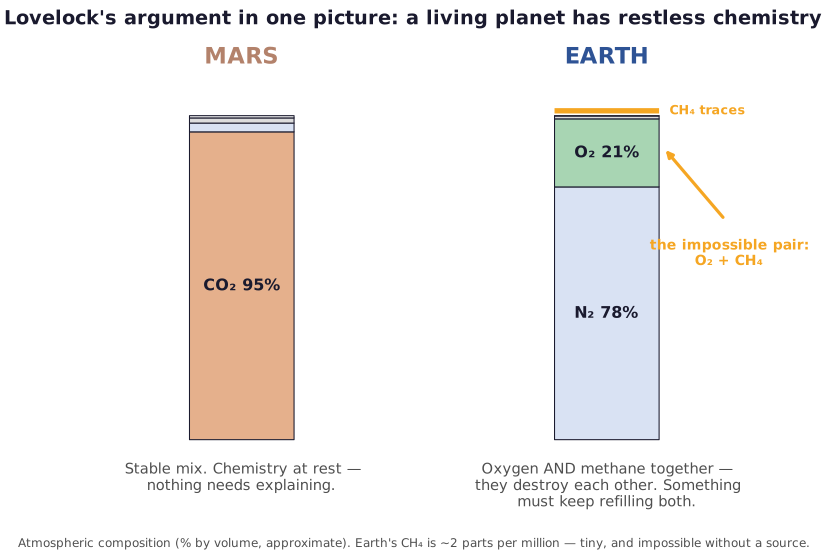
Today we all work on the same paper, together. Two reasons. Next class, you'll ask these same four questions about an AI's summary of this paper, and compare. And this paper comes back in Unit 1. So keep today's OPVL. You'll use it twice more.
One more skill today. A science paper mixes four kinds of sentences: things the scientist saw (observation: 'Mars's atmosphere is mostly CO₂'), things they worked out from what they saw (inference: 'so Mars is probably lifeless'), things they're arguing (claim: 'you can test for life from orbit'), and things they simply think (opinion: 'this is the best way to look'). Telling these apart is what makes your Value and Limitations specific instead of vague.
Before you start the work
Start with the Lovelock paper itself, because today is when you meet it. Then the Watch, where OPVL is modelled with the class and projected, and then the Interact that closes the reading. Notes go in your Class Notebook as a Power outline.
Help if you want it Taking notes? Power 1 seeds for today
- Start with the reading companion, linked below. Work through its nine steps. About five minutes, and you will know what the paper argues before you meet it.
- Then open the reading tool from Google Classroom. That is where the paper itself is, with the reading support built in.
- In the tool, the marked paragraphs are the ones that carry the argument. Read those closely. Skim the rest, but do look at what kind of writing it is.
- Any word with a dotted underline opens a definition. There is a language selector at the top if you want it in Korean, Japanese, Chinese, French, Spanish or German.
- If the paper is hard going, open "New to reading a scientific paper?" at the top of the tool before anything else.
· Lovelock, J. E. (1965). A physical basis for life detection experiments. Nature, 207(4997), 568–570.
· Thompson, M. A., et al. (2022). The case and context for atmospheric methane as an exoplanet biosignature. PNAS, 119(14), e2117933119.
In Google Classroom for this block: the article PDFs, the Lovelock Pre-Read Scaffold (a guided walk through the paper; use it today, while you read), the vocabulary handout, and the structured OPVL template. If the paper feels hard, that's expected: it's a research paper and you have scaffolds.
Today's work
One task today. Everyone does the same thing, because next block depends on you having done it.
Your own dossier sources get their OPVL in Block 4, not today.
With a partner, complete Value and Limitations on Lovelock using the structured OPVL template. Origin and Purpose we did together as a class. Your Limitation must be specific to this paper. "Pre-Viking, so essentially no Mars surface data" works. "It's old" does not, because it could be said about almost any source. Keep this OPVL. Block 3 compares it against an AI's version of the same paper.
Preview Thompson et al. (2022), the modern paper that turns Lovelock's idea into something a real telescope can test. Same idea, fifty-seven years more data behind it. Write one sentence: what does Thompson's Value have that Lovelock's does not, and why?
Come to the help table. We work the OPVL letter by letter with the sentence stems in front of us. Being stuck on a 1965 paper in your second week is the expected outcome, not a problem.
The Lovelock pre-read uses five terms worth previewing: biosignature · thermodynamic equilibrium · entropy · photolysis · phenomenological. Definitions, visual cues, and sentence stems are on the U0 EAL Pre-Teach reference + the Block 2 vocabulary handout in Google Classroom.
Open your Class Notebook and type today's entry header as Heading 2:
A: Aug 12 | U0 B2 | OPVL Across Source TypesB: Aug 13 | U0 B2 | OPVL Across Source Types
What you're submitting today
Graded formative. This one gets Knowledge & Understanding and Thinking & Transfer bands, returned before Block 4 so you can use the feedback on your dossier. It is not part of the dossier's own grade.
Your full OPVL on Lovelock (1965) on the structured template. 4–8 sentences. The Limitation must be specific to this paper, not "could be biased." This OPVL carries forward. You'll compare it to an AI summary OPVL in Block 3, and meet Lovelock again in Unit 1 Block 1. There is also homework tonight, your first login to Flint: see Before next class at the bottom of this page.
Submit via Google Classroom (link posted in August)Before next class
Today's reflection happens at home instead of in the last five minutes. This is your first time logging into the class AI platform, so the job is to get in and try the tool. Nothing here has to be polished.
No grade. You bring it to Block 3.
Check Google Classroom for which platform your section uses, then sign in with your school account. On Flint, find the Source Evaluator, the OPVL tool. On BoodleBox, open a new chat. Either way, run it on Lovelock (1965), the paper you worked on today. Save the conversation.
Bring three things to next class:
- Your output, meaning what you and the tool produced together.
- What was helpful. Name the moment it actually moved your thinking, not "it was useful".
- Where it was difficult. Logging in, the wording, the questions it asked, an answer you could not check. Anything that slowed you down counts.
The Source Evaluator marks where you are: [O 1/4] for Origin through to [L 4/4] for Limitations. It will move you to the next letter after about three exchanges, even when your answer still feels rough. That is deliberate. Last time this ran, every conversation spent the whole period on Origin and never reached Limitations, which is the letter your Dossier is weakest on and the one the rubric looks hardest at. A rough L beats a flawless O.