← Back to Unit 0 · Block 1
The AP article you just read is a news story ABOUT a report. This page is selected points from the report itself: the United Nations University Institute for Water, Environment and Health (UNU-INWEH), June 2026. Same facts, different source type. Notice what changes.
The numbers AP reported, straight from the source
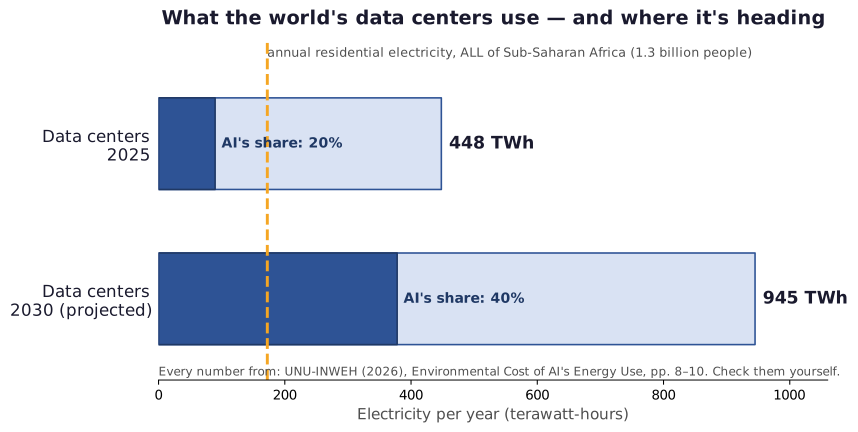
- In 2025, global data centers consumed an estimated 448 TWh of electricity. If data centers were a country, they would rank 11th in the world by electricity consumption. (p. 10)
- That electricity carried a carbon footprint of 189 million tonnes of CO₂e; offsetting it would take 3.2 billion tree seedlings grown for 10 years, roughly every tree in the United Kingdom. (p. 10)
- The water footprint: 4.5 trillion liters (1.8 million Olympic-sized pools, or the annual basic domestic water needs of over 600 million people in Sub-Saharan Africa). (p. 10)
- AI accounted for roughly 20% of data centers' electricity in 2025, projected to reach 40% by 2030. (p. 10)
- Projected 2030 consumption: over 945 TWh (nearly 3% of global electricity, ranking 6th if it were a country). (p. 10)
Scale you can feel: the numbers that didn't make the headline
- A typical ChatGPT-style text query is about 200 times more energy-intensive than a spam-filter check. (p. 9)
- Generating one AI image takes about 2.9 Wh, and a water footprint of about two tablespoons (29 mL). (p. 9)
- One high-complexity AI video clip draws more than 415 Wh, with a water footprint of 4.1 liters: almost a two-day drinking water need for one person. (p. 9)
- Training GPT-4 used roughly 600 million liters of water, about 237 Olympic-sized pools. (p. 8)
- By 2030, AI infrastructure could generate up to 2.5 million metric tons of e-waste per year: nearly 250 Eiffel Towers, every year. (p. 10)
Page 11 of the report carries an AI-generated illustration, and directly beneath it, this disclosure: "AI-generated conceptual image of AI's environmental footprint, generated using OpenAI's ChatGPT/DALL·E, May 2026. Estimated footprints per standard-resolution AI image: 2.9 Wh electricity, 1.22 g CO₂e, 28.6 mL of water, and 0.45 cm² of land."
The UN used AI to make an image, said so, and told you exactly what it cost. Keep that move in mind; you'll meet it again in Block 3.
Questions to bring to class
- Who wrote this, and for whom? (Check the authors and the institute; then check who funds it.)
- AP wrote "more than all but 10 countries." The report says "would rank 11th." Same fact. Does it feel the same?
- What can't this report know? (Hint: it says its own data-center figures depend on what companies disclose.)
Source
Aczel, M., Chamanara, S., Matin, M., Farsi, A., Marwala, T., Madani, K. (2026). Environmental Cost of AI's Energy Use: Carbon, Water and Land Footprints. UNU-INWEH, Richmond Hill, Ontario, Canada. DOI: 10.53328/INR26RMA002.
Report landing page · Full PDF (free)
Selected points reproduced under the report's educational redistribution terms, with acknowledgment as required.