OPVL is a framework for evaluating any source you cite: a news article, a peer-reviewed paper, a government data set, an AI-generated explanation, a TikTok video. Every source has four things you should be able to say about it before you let it into your work.
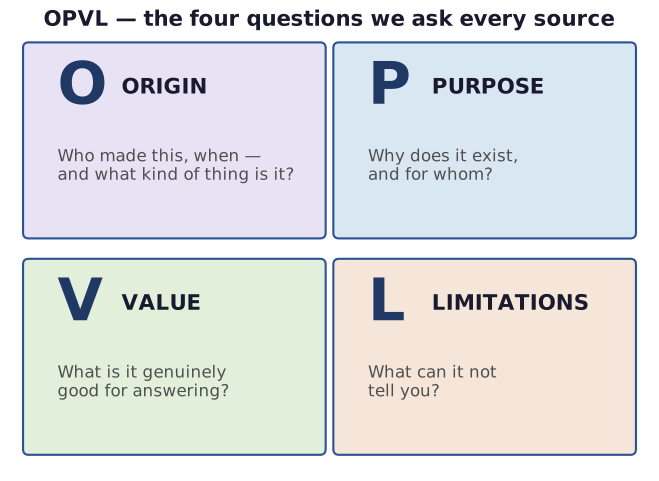
The four questions
| Letter | Question to answer |
|---|---|
| O: Origin | Who created this source? When? Where? Why was it created? Who paid for it (if relevant)? |
| P: Purpose | What was this source intended to do? Inform? Persuade? Sell? Educate? Entertain? Who was the intended audience? |
| V: Value | What does this source tell us that's useful? What kind of question can it help us answer? What does it do well that other sources don't? |
| L: Limitations | What does this source NOT tell us? Where might it be biased, incomplete, outdated, or wrong? What would you need a different source for? |
Why this framework
You're going to encounter thousands of claims about the natural world over the next ten years: about climate change, vaccines, AI, energy, food. Some of those claims will be from peer-reviewed scientists. Some will be from TikTok influencers. Some will come from AI that confidently makes things up. OPVL is the muscle that lets you tell those apart, not by deciding who to trust forever, but by deciding what each source is actually good for.
OPVL on common source types
Five reference templates, not full evaluations. You'll do full OPVL on specific sources in your Source Dossier. For a complete worked dossier with band annotations, see the U0 exemplar.
Peer-reviewed scientific paper
- O: Researchers at named institutions; published in a named journal; specific year. Often funded by a grant or government agency (check the acknowledgements).
- P: To communicate new findings to other scientists. Designed to be reproducible, criticizable, and built on.
- V: Best source for what scientists actually found in a specific study. Includes methodology, uncertainty, and limitations stated by the authors themselves.
- L: Narrow in scope, one study answers one question, not the whole topic. Written for experts; jargon-dense. May be behind a paywall. May be retracted or updated later (check status).
Government scientific agency (USGS, IPCC, NASA, IMD)
- O: Public-sector scientific organization, often legally mandated to report on a specific topic. Funded by taxpayers. Specific publication date.
- P: To inform policy and the public with consensus scientific findings. Often summarizes many peer-reviewed studies.
- V: Authoritative for current scientific consensus. Usually has data, maps, and well-vetted explanations. Updated regularly.
- L: Can lag behind the most recent research by 1–5 years. Political pressures may shape how findings are framed (especially in press releases vs. underlying reports). Country-specific agencies may have country-specific framing.
Major news outlet (BBC, Reuters, The Hindu, NYT)
- O: Professional journalists at an established outlet; specific reporter named; published date listed.
- P: To inform a general audience about current events. Has commercial pressures (clicks, subscriptions) alongside journalistic standards.
- V: Useful for getting the human story, dates of events, and quotes from involved parties. Good for understanding how an issue is being publicly framed.
- L: Reporters are not scientists. Simplifications can mislead. Headlines often overstate findings. May rely on a single expert source. Different outlets emphasize different angles.
Corporate or industry communication (sustainability report, press release)
- O: Company communications team, often year-end. Published by the company itself; specific company named.
- P: To inform investors, regulators, and the public about company activities. Almost always intended to make the company look responsible.
- V: Useful for understanding what the company claims about itself. Sometimes includes data not available elsewhere.
- L: Selection bias is enormous, companies report what makes them look good. Independent verification often missing. Useful as one data point alongside critical sources.
Social media post / influencer content
- O: An individual or small team; published instantly; often anonymous or pseudonymous. Algorithmic distribution.
- P: To gain attention, build a following, sell something, or persuade. Engagement is the metric.
- V: Useful for tracking emerging public conversation. Sometimes surfaces real on-the-ground reporting. Useful as a clue to what people are talking about.
- L: Often no fact-checking. Strong incentives toward outrage and oversimplification. Source verification difficult. May be coordinated misinformation.
AI source (a course partner on your class platform)
- O: Which AI did you use? What version, if you know it? When was its training data cut off? When did you use it? (Date matters: AI improves.)
- P: What is this AI designed for? A general-purpose assistant, or a partner built for one job like the Plate Tectonics Tutor? Is it tuned to be helpful, accurate, brief, or creative?
- V: What did it help you do that you couldn't have done as fast or as well alone? Did it surface knowledge, explain a concept, generate options, give feedback, translate, summarize? Be specific about what it added.
- L: Where is this AI likely wrong? Did it make up a source, a statistic, or a date? What domains is it weak in? When did it refuse or hedge? What did it confidently say that you later found was incorrect?
Next
AI sources have one additional requirement: every time you use AI in your work, you also fill out the documentation template. See AI Documentation Protocol for the template, the failure modes specific to AI, and three worked examples.