Block 4: Source Dossier Launch + Choosing Your Topic
From last block: three AI responses to the same paper said different things, and one of them named a chemical the paper never mentions.
Task: If you had to pick a science topic where you would expect sources to disagree with each other the most, what would it be, and why that one? 60 seconds with a partner. Hold your answer; you will use it in ten minutes.
Answer in your Field Notebook, dated.
I can choose and justify a contested topic for my Source Dossier, and identify and begin OPVL on my first source.
I can find sources, judge them with OPVL, and communicate what I learned honestly.
"Obtaining, Evaluating, and Communicating Information"
Where this runs:
- U0 B1: Welcome + How We Work
- U0 B2: OPVL Across Source Types
- U0 B3: AI as a Source + Documentation Protocol
- U0 B4: Source Dossier Launch + Choosing Your Topic ← you are here
- U0 B5: Source Dossier Work Day 2: AI Source + Documentation
- U2 B9: Landscape Readings Submitted + Class Share-out
Assessed:
Source Dossier (all strands) + every OPVL component after it
On track looks like:
Your Limitations are specific to the source in front of you, never 'it might be biased.'
I can check an AI's answer against real sources and decide: use it, fix it, or bin it.
In brief: "Evaluate whether an AI output should be accepted, revised, or rejected (paraphrased; full framework at ailiteracyframework.org)"
Where this runs:
- U0 B1: Welcome + How We Work
- U0 B2: OPVL Across Source Types
- U0 B3: AI as a Source + Documentation Protocol
- U0 B4: Source Dossier Launch + Choosing Your Topic ← you are here
- U0 B5: Source Dossier Work Day 2: AI Source + Documentation
- U1 B1: Phenomenon Launch: What Makes a Planet Habitable?
- U1 B3: Mars as Calibration: What Does Earth Have That Mars Doesn't?
- U1 B5: Exoplanet Detection: Transits and What They Tell Us
- U1 B6: Reading Exoplanet Data Cards: Choosing Your Planet
- U1 B7: Habitability Framework: Building the Comparison
- U2 B3: Rivers as Landscape Sculptors
- U2 B6: Field Photo / Map Analysis Work Day
- U2 B7: Reading the Landscape: Worked Example + OPVL
- U4 B5: IPCC AR6 Deep Dive + Chennai Climate Brief Assigned
- U4 B6: Climate Models: How They Work, How They're Wrong, How to Read Them
Assessed:
Every AI Documentation Template: the 'one thing the AI got wrong' field
On track looks like:
You catch specific errors ('it said 2024; the report says 2023'), and you've stopped writing 'AI can hallucinate.'
What today is about
The unit project starts today. Everything in Blocks 1 through 3 was preparation for it.
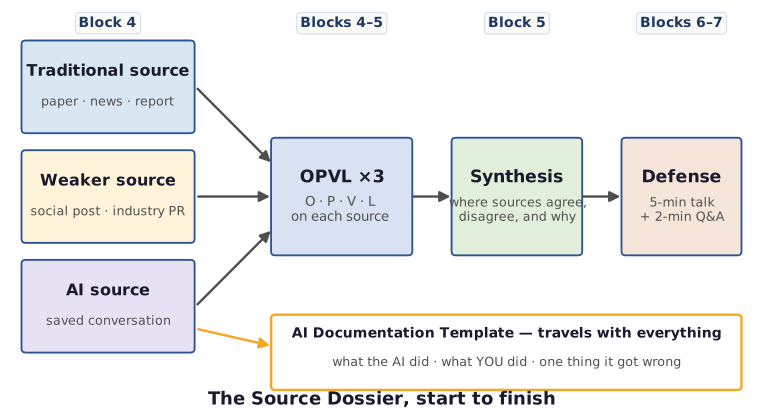
Here is the whole thing: pick one contested scientific topic, find three sources of different kinds, OPVL each one, work out where they disagree and why, and defend your evaluation in a five-minute talk. That is the Source Dossier, the Unit 0 summative. It is due at the start of Block 7 and defended in the same block.
You already have every skill it needs. Block 1 gave you two texts on one flood that did not agree. Block 2 put you inside a real 1965 paper. Block 3 showed you three AI responses to that paper, one of which confidently named a chemical Lovelock never wrote down. The dossier just asks you to do all of that on a question you picked yourself.
Today is about choosing well, because a badly chosen topic makes the next three blocks miserable. You will test candidate topics against one standard: do serious sources actually disagree about this? Then you lock it with Ms. Jayanthi/Mr. Matt and start hunting your first source.
"Traditional" in the source list means "not generative AI": a textbook chapter, a news article, an interview, a peer-reviewed paper, a primary document. You OPVL two of those and one AI source. Separating them is deliberate, so you can feel what OPVL reveals about each type. The same four questions; very different answers.
Before you start the work
Start with the Watch: the project brief walked through end to end. The Reads are what you will keep coming back to for the rest of the unit, and the Interact is where you pressure-test your topic before committing to it.
Today's work: choose one path
Topic conferences with Ms. Jayanthi/Mr. Matt run all block; come to the desk when you are ready. Everything else is source-hunting. The path you pick is about how settled your topic already is.
Open your Class Notebook and type today's entry header as Heading 2:
A: Aug 18 | U0 B4 | Source Dossier: Topic Choice and First SourceB: Aug 19 | U0 B4 | Source Dossier: Topic Choice and First Source
The Source Evaluator marks where you are: [O 1/4] for Origin through to [L 4/4] for Limitations. It will move you to the next letter after about three exchanges, even when your answer still feels rough. That is deliberate. Last time this ran, every conversation spent the whole period on Origin and never reached Limitations, which is the letter your Dossier is weakest on and the one the rubric looks hardest at. A rough L beats a flawless O.
What you're submitting today
Submit your locked topic with its justification, plus whatever you have of source one. Feedback only: no bands on this one.
Three things. Your topic. Two or three sentences on why it is genuinely contested, naming the two positions that disagree. And your first source with its OPVL started, however far you got.
The justification matters more than it looks. A topic where you cannot name two opposing positions will not survive the synthesis in Block 6, and it is much cheaper to discover that today.
Submit via Google Classroom (link posted in August)One question before you leave
Three to five minutes. Your answer is saved to your reflection journal, where you can read back everything you have written this year.
Bring this to Block 5.
Today's reflection is in Google Classroom, under Reflection Journal.
Link posted in AugustSign in with your school account. Your teacher can see what you write here.
Before next class
Block 5 is the AI source and the documentation, and it needs your two traditional sources already done. This is the one substantial piece of homework in Unit 0.
Graded formative, same as your Lovelock OPVL. You bring it to Block 5.
Finish the OPVL on your traditional reputable source and complete one on your potentially weaker source. Four to eight sentences each, on the structured template.
Two things to hold on to while you write:
- The Limitation must be specific to that source. "Could be biased" is not a Limitation, it is a shrug. Name what this particular source cannot tell you and why.
- "Weaker" does not mean wrong. It means different Origin, Purpose, Value, and Limitations. If your weaker source turns out to be right about something, that is worth writing down.