Why you're doing this
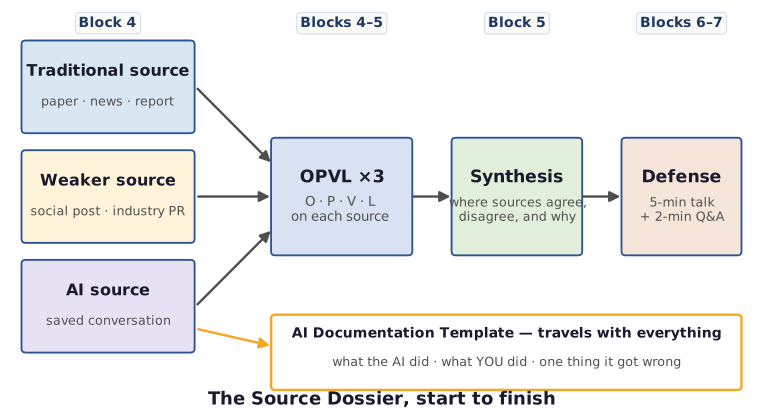
Over the next nine months you'll evaluate hundreds of sources: papers, news, government reports, AI outputs, your classmates' arguments. The Source Dossier is the first time you do that work for a grade. It's intentionally small: pick one contested scientific topic, find three sources (including at least one AI source), OPVL each, and defend your evaluation in 5 minutes.
Why "contested"? Because uncontested topics don't force you to actually evaluate sources; you just agree with whichever one you read. Contested topics force you to notice that sources disagree, ask why, and figure out which source is good for what.
What contested means here, and what it does not
Contested means informed people who have looked at the evidence still disagree, usually about what it means, what to do, or who carries the cost.
It does not mean a settled question that some people are wrong about. Whether the Earth is warming is not contested. Whether the 2015 Chennai flood was made worse by warming, and by how much, is. The second is a real question. The first is a search for someone to argue with, and it makes for a thin Dossier.
Can you name two people who both know the field well and would still disagree? If the only disagreement you can find is between experts and people who have not read anything, pick something else.
Step 1: Choose your contested topic
Pick one. If you want to propose your own contested scientific topic, talk to your teacher by Block 3.
Chennai and Tamil Nadu
Strongest choice if you want sources nobody has pre-digested for you. Local reporting, government documents, and people who live with the consequences. Some sources will be in Tamil, which is an advantage.
| Topic | Why it's contested |
|---|---|
| Pallikaranai marsh: how much should be restored, and what happens to what is built on it? | The marsh covered around 5,500 hectares in the 1960s and is under 700 now. Ecologists, the state, developers and residents disagree about how much can realistically be recovered and who absorbs the loss. |
| The 2015 Chennai floods: how much was rain, and how much was planning? | Rainfall records, reservoir release decisions and construction on floodplains all played a part. Serious people weight them very differently, and the weighting decides who is responsible. |
| Is desalination the right answer to Chennai's water problem? | Desalination is expensive, energy-hungry and produces brine. Supporters say the alternative is running out of water. Critics say it funds supply instead of fixing distribution and leakage. |
| Ennore Creek: whose measurements do you believe? | Fly ash and effluent near the thermal plants. Industry monitoring, TNPCB data and fishing communities' accounts do not agree, and each side has a reason to measure differently. |
| River sand mining: construction necessity or an aquifer being emptied? | Sand is needed to build, and removing it changes riverbeds and groundwater. The legal and illegal versions blur together, which makes sources unusually hard to trust. |
India
| Topic | Why it's contested |
|---|---|
| The India-based Neutrino Observatory in Theni: good science in the wrong place? | Physicists say the site is scientifically necessary. Ecologists and local residents object to tunnelling under a protected landscape. Both arguments come from people who understand their own field well. |
| Should India build more nuclear power? | A genuine energy debate: low-carbon and reliable, against cost, waste, siting and accident risk. The answer depends on what you compare it to. |
| Electric vehicles in India, accounting for a coal-heavy grid and battery mining | The answer changes with where the electricity comes from and where the lithium and cobalt came from. Both supporters and critics cite real numbers. |
| Why did the MMR and autism claim survive after it was retracted? | The science is settled and the claim is not. This is a question about how information spreads and who repeats it, which is exactly what OPVL is for. Do not treat vaccine safety itself as an open question. |
Global
| Topic | Why it's contested |
|---|---|
| The water and energy footprint of AI data centres | Estimates vary enormously, companies disclose selectively, and the field moves faster than the studies. You will also be using AI to research AI, which is worth noticing. |
| Do forest carbon offsets actually work? | Investigative journalists and offset certifiers have reached opposite conclusions about the same projects. One of the cleanest cases of two credible sources disagreeing about checkable facts. |
| Deep-sea mining for battery metals | Needed for the energy transition, and it disturbs ecosystems nobody has finished describing. Scientists disagree about how much damage is recoverable. |
| Sunscreen: chemical against mineral, and the reef question | Two real debates layered on each other, with cosmetics companies, dermatologists and marine biologists all publishing. Excellent practice on Value and Limitations. |
| One nutritional supplement, chosen by you | Melatonin, ashwagandha, creatine, a vitamin. Industry-funded trials against independent reviews, on a product somebody you know probably takes. |
| GM crops: food safety against ecological effect | Real scientific consensus on food safety, and a genuine ongoing argument about ecological and economic effects. Keeping those two apart is most of the work. |
Step 2: Find three sources of different types
You must include at least one source of each type below. The third can be from any category.
- A traditional reputable source. Peer-reviewed paper abstract, government agency (USGS, IPCC, WHO, NASA, IMD), or major news outlet (BBC, Reuters, The Hindu, NYT, Nature News).
- A potentially weaker source. Social media post, corporate communication, industry-funded study, tabloid news, or a TikTok / YouTube video that makes a scientific claim. Note: "weaker" doesn't mean wrong. It means it has different Origins, Purposes, Values, and Limitations than the traditional source.
- An AI source. Ask your class AI platform to explain your topic. Save the conversation. This is the source you'll OPVL like any other AND document with the AI Documentation Template.
Step 3: OPVL each source
For each source, complete the full OPVL framework: Origin, Purpose, Value, Limitations. Each OPVL should be 4–8 sentences.
Step 4: Cross-source synthesis
After you've OPVL'd each source individually, write a synthesis section (~300 words) that answers:
- Where do the sources agree? Where do they disagree?
- Based on your OPVL of each, which source is most useful for which question?
- What would a person who only read your AI source not know that your traditional source covers?
Step 5: AI Documentation
Fill out the AI Documentation Template for the AI source. This is not optional. Submit it as a final page of your Dossier or as a separate attachment.
If the AI Documentation Template is missing or trivially completed, the dossier is returned as incomplete and is not scored until the documentation arrives. No strand is capped.
The "one thing the AI got wrong" field is part of a complete template, and a specific answer there is what earns the higher T/T bands.
See the rubric for the full bands.
Step 6: Defend it
Your three sources disagree. Does that disagreement mean one of them is wrong, or does it mark a place where the evidence is not yet good enough to settle the question? How would you tell the difference?
This one cannot be answered by reciting what you found. It asks what your work shows about how this kind of problem behaves, which is the part that travels to the next unit.
5-minute pitch + 2-minute peer Q&A. Required content for the pitch:
- 30-second intro: your topic + why it's contested
- 90 seconds: walk us through one source: the OPVL move you're proudest of
- 90 seconds: walk us through your AI source: what it got wrong and what it added
- 60 seconds: cross-source synthesis: what would someone miss by only using one of these?
- 30 seconds: what you'd do differently if you had three more sources
Alternative (pre-approved by Block 5): a written essay (~1200 words) covering the same five parts in the same order. No penalty for choosing it; the same rubric applies.
Format guidance
- The Dossier: ≤1500 words excluding citations. Google Doc or PDF.
- Sources: cite each fully (author, title, source name, date, link). Use any consistent citation style (MLA, APA, Chicago; pick one).
- AI Documentation: last page of the Dossier or a separate file. Full template fields completed.
How this is scored
The Source Dossier is scored against the AISC Science strand rubric: three strand scores (K/U / T/T / C) reported as a triplet, not summed. See The Rubric for the full bands and the two gates above.