← Back to Unit 1 · Block 5
Reading time ~5 min
Help if you want it Taking notes? Power 1 seeds for today
Nobody has ever photographed the surface of a planet outside our solar system. Read that again, because the artist's impressions are so good that it's easy to forget. Almost everything we know about exoplanets comes from watching stars very, very carefully and noticing when their light does something slightly odd.
The workhorse technique is the transit method. If a planet's orbit happens to carry it between its star and our telescope, the star gets dimmer while the planet crosses. Not dramatically dimmer. When TRAPPIST-1e transits its small star, the light drops by well under one percent. Detecting an Earth-sized planet this way is like noticing, from kilometers away, that a moth flew in front of a floodlight. It works because telescopes like Kepler measured starlight with obsessive precision, for years, without blinking. Kepler alone confirmed more than 2,600 planets this way.
A transit is a shadow, and shadows carry information. The depth of the dip tells you the planet's size relative to its star: the bigger the planet, the more light it blocks. The timing tells you the orbit: if the dip repeats every 4.2 days, the planet circles its star every 4.2 days. Repetition also separates real planets from flukes; one dip could be many things, but the same dip returning on schedule, transit after transit, is a planet.
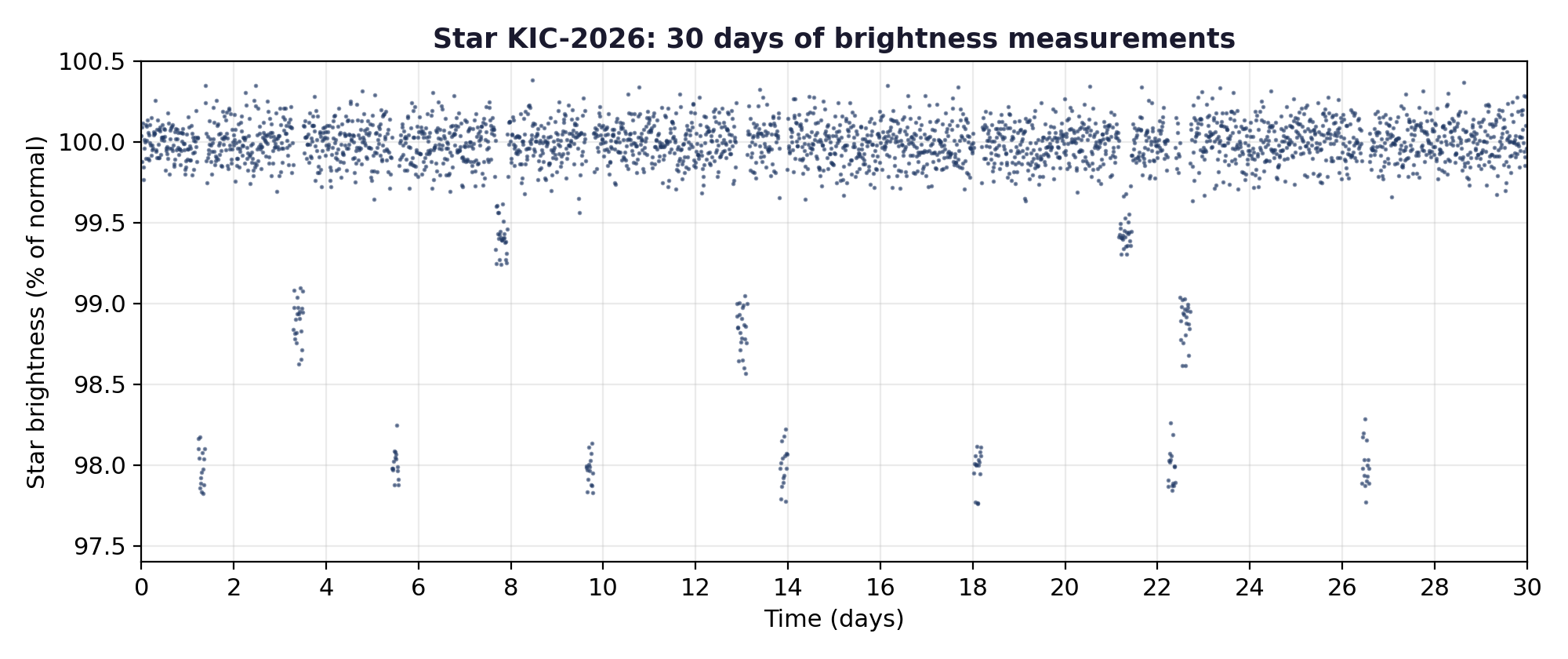
Just as important is what a transit cannot tell you. It gives no mass (for that, astronomers measure the star's wobble with a different technique). No composition: a dip can't distinguish rock from ocean from gas. No temperature. No atmosphere. And nothing, nothing at all, about life. A bare transit detection tells you the size and orbit of something. Everything beyond that comes from follow-up work or from inference, and inference must be labeled as such.
There's a clever extension. During a transit, a sliver of starlight passes through the planet's atmosphere, if it has one, on its way to us. Different gases absorb different wavelengths, so the starlight arrives with chemical fingerprints. This is transmission spectroscopy, and it's how JWST found water vapor in the atmosphere of WASP-96 b in 2022. It's the technique behind nearly every headline about exoplanet atmospheres, and it's hard: the signal is tiny, and a result from one paper is sometimes reversed by the next. When your data card says a claim is "contested," this is usually where the contest lives.
One more limitation deserves respect: geometry. Transits only work when an orbit happens to line up edge-on with our view. Most don't. For every planet we catch transiting, many more orbit unseen, their shadows falling in some other direction. The transit method doesn't survey the galaxy; it samples the lucky alignments. Good scientists keep that bias in mind, and so should your Report.
Why does this matter to you this week? Because every number on your exoplanet's data card was earned by some observation, and the observations are not equally strong. A transit-measured radius is among the most reliable numbers in the field. A mass may be a model estimate. An atmosphere claim may hang on a single contested spectrum. When you OPVL your data sources in Block 8, the question "what observation is this claim actually standing on?" is the whole game. Pop-science coverage blurs these lines constantly; a transit detection becomes "scientists find habitable world" by the third headline. Your job is to keep the lines sharp.
Sources
- Transit method mechanics and the alignment requirement: NASA Exoplanet Exploration Program, "5 Ways to Find a Planet," exoplanets.nasa.gov/alien-worlds/ways-to-find-a-planet [government science agency; interactive]
- Kepler's confirmed-planet count: NASA Kepler mission overview, nasa.gov/kepler [government science agency]
- WASP-96 b water vapor: NASA Webb first-images release (July 2022), nasa.gov [agency press release; the same spectrum you'll see projected in Block 10]
- Your planet's data card values: NASA Exoplanet Archive, exoplanetarchive.ipac.caltech.edu [primary data archive; where "check the archive" always points]
Go deeper: the "5 Ways" interactive above: the transit method and its four siblings, animated.