1. Why defense, and why it's not just a presentation
A presentation is something you give. A defense is something that happens to you. The difference matters. In a presentation, you control the room: you deliver your prepared content, you take a couple of friendly questions, you sit down. In a defense, you put your argument forward and other people, peers in role, the teacher, sometimes guests, push on it. They ask follow-ups. They cite evidence you didn't address. They press on the assumption you glossed over. The room is not yours.
This sounds harder, and it is. It is also more honest. Almost every consequential decision in your adult life will be made in a defense format, not a presentation format. The job interview where they push back on your salary expectation. The graduate-school committee meeting. The funding pitch. The court hearing. The professional review board. None of those is a presentation. All of them are defenses.
So when we design the NASA Q&A, the Defense Panel, the Stakeholder Roundtable, the Policy Panel, the Regional Planning Board, the Op-Ed reading. We are not making your assessment "more theatrical." We are putting you in the form your adult professional life will repeatedly demand of you, while you are still practising, in a room that is on your side.
2. The five question types, and how to recognize them
Every question a panelist asks you is one of five types. The first move in any defense is recognizing which type you just got.
Type 1: Comprehension check
The questioner wants to know if you actually understand a concept you used. "When you say tectonic plates are stuck together by friction, what does that mean physically?" These are NOT attacks. They are tests. Demonstrate the understanding clearly and concisely. If you can't, admit the gap and offer to find out, see Move 4 below.
Type 2: Evidence challenge
The questioner accepts your reasoning but pushes on your evidence. "You cite Source X to support that claim, but Source X actually says something narrower. How do you respond?" Know your sources well. Engage the specific evidence point: either by clarifying the source, by acknowledging the limit, or by citing additional evidence.
Type 3: Position challenge
The questioner accepts your evidence but disputes your conclusion. "You've shown the data, but I don't think it supports the policy recommendation you're making." The hardest type. Articulate the reasoning bridge between evidence and position, and engage WHY the questioner sees a different bridge. This is where revision-under-questioning happens (Move 5).
Type 4: Hostile or trap question
The questioner asks something framed to make any answer look bad. "So you're saying the farmers in Karnataka should just lose their water rights?" Rare in this course (we coach panelists away from them) but you should know how to handle one. Reframe: separate the question from its loaded framing, answer the underlying question, and name the reframe explicitly. "I'm not saying farmers should lose rights: I'm saying the current allocation has costs I want to make visible."
Type 5: Clarification request
The questioner is confused about what you said. "When you said 'capacity factor was 30%,' do you mean the plant runs 30% of the time, or it produces 30% of its rated output?" Easy and welcome. Clarify in different words than you used the first time, and thank the questioner for surfacing the confusion.
About how you worked
One category sits outside the five types, because it is not about your content. It is about your process, and it is standing: it comes up whatever you are defending.
- "Which part of this did you do without AI, and why that part?"
- "If you could change one thing about the AI partner you used, what would it be and why?"
3. What makes defense fail
Four failure modes show up repeatedly. Recognize them in yourself.
3a. The over-prepared script
You memorize answers to every anticipated question. The panelist asks something slightly different from what you rehearsed. Your brain goes blank because the script doesn't fit. The failure is not the stumble. It is the script. Defenses are not lectures; you cannot memorize your way through them. Prepare understanding, not phrases.
3b. The dodge
The panelist asks a hard question. You answer a related but easier question. The audience notices. Your credibility drops. The discipline: pause, re-state the question in your own words to confirm, then answer the question that was asked.
3c. The retreat
The panelist pushes once. You agree completely and abandon your position. You think you're being intellectually humble. You are actually being intellectually slack: you put forward a position you didn't have the conviction to hold under one question. Real intellectual humility revises position when given better evidence, not when given mild pressure.
3d. The dig-in
The panelist gives you a strong counter-argument. You restate your original position in the same words, louder. You think you're being principled. You are actually refusing to engage. Real principled defense engages the counter-argument substantively.
4. What makes defense work
- Pause before responding. 8–12 seconds of silence is normal for composing a careful answer. Panelists who fill silence with more talk are giving you cover; use the gap. The discipline is hardest on the FIRST question, when adrenaline is highest.
- Restate the question in your own words before answering. "Let me make sure I'm hearing the question correctly: you're asking whether…" This confirms understanding, gives you a few more seconds of think time, and makes a dodge much harder.
- Locate your answer in evidence. Don't say "I think…" when you can say "According to the Climate Data Reference, page 4…" or "In my hazard profile I cited the 1985 Mexico City earthquake, which shows…" Defense is not about your opinions; it is about your reasoning from sources.
- Treat the panelist as an ally trying to make your argument stronger, not an opponent trying to take it down. A panelist who finds a weak point in your reasoning has done you a favor. They have shown you where your argument needs work BEFORE it has consequences in the real world. Thank them.
5. The five moves we teach
Move 1: "Could you say that another way?"
Legitimate, useful, and not a sign of weakness. Use it when the question is ambiguous, when you missed part of it, when the framing is loaded, or when you want a few more seconds to think. Skilled defenders use this move all the time. Use it without apology.
Move 2: "According to [source X]…"
Anchor every substantive claim in a specific source. Defense is not where you assert; it is where you cite. The Source Dossier work you did in U0 is the foundation for this move all year. Citing source-by-source is the most direct way to demonstrate the K/U strand of the rubric.
Move 3: "That's a fair point, and here's how I'd address it…"
Acknowledge the strength of the questioner's challenge before responding. This is not weakness. It is intellectual honesty PLUS effective rhetoric. A panelist whose point you acknowledge is more likely to hear your response. A panelist whose point you dismiss is more likely to escalate. This move is the single biggest difference between defenders who get steamrolled and defenders who hold the room.
Move 4, "I don't know, but here's how I'd find out"
This is the move that takes the longest to learn and matters the most. When you genuinely don't know the answer to a question, the wrong moves are: pretending you do, making something up, or freezing. The right move is to admit honestly AND demonstrate that you know HOW to find out.
Panelist: "What was the magnitude of the 2001 Bhuj earthquake?"
You: "I don't remember the exact magnitude, I'd cite the USGS Earthquake Catalog to confirm. From my hazard profile I know it was a large continental intraplate event, M7-class, with intensity high enough to collapse multi-story buildings hundreds of kilometers from the epicenter. I'd want to verify the magnitude figure before stating it definitively."
This answer is BETTER than a guessed-correct number. It demonstrates: honesty about the gap, knowledge of where to find authoritative data, and substantive understanding of what you DO know about the event. Panelists score this highly.
Move 5: "You've changed my mind on that"
If the panelist gives you a stronger argument than you had, say so. Adjust your position. Then go on. This is not capitulation. It is intellectual honesty under live pressure, and it is one of the highest-skill moves in any defense format. The student who can revise their position mid-defense and articulate WHY is demonstrating exactly the kind of thinking the T/T strand of the rubric rewards.
The condition: the revision has to be genuine. Saying "you've changed my mind" to make a hard question stop is the retreat (3c) in disguise. The real version is: you heard a better argument, you weighed it, you changed your view, you can explain WHY the new view is more defensible than the old one.
6. The answer pattern
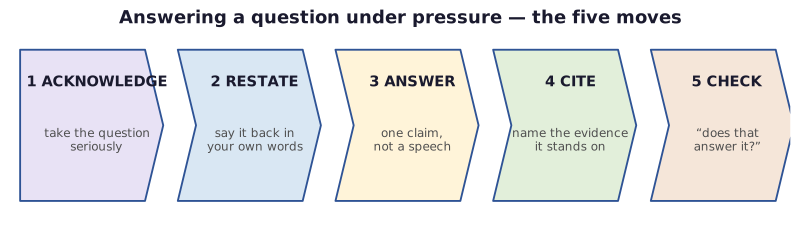
What every Q&A answer models:
- ACKNOWLEDGE the question honestly (including "that's the weak spot" when it is).
- RESTATE it in your own words so everyone hears what you're actually answering.
- ANSWER directly. One claim, not a speech.
- CITE the specific evidence or source your answer stands on.
- CHECK back: "does that answer it?" Invites the follow-up instead of fearing it.
7. Strong vs. weak: same question
For class discussion after watching. Same panelist question:
Strong answer
"The source is the WHO report itself. The AI said 'considered safe.' Page one of the report's summary says the evidence is insufficient to conclude risk. I had both open side by side, and my AI Documentation quotes the exact line from each. You could check it in about a minute."
8. Preparation: how to anticipate
Most defense failures are preparation failures, not in-the-moment failures. The students who handle live questions best are not the most quick-witted in the room. They are the ones who anticipated 80% of the questions in advance and rehearsed their thinking through them.
- Look at the question bank if one is provided. The Defense Panel role-cards, the NASA Q&A bank, the Stakeholder Roundtable question lists. These are not secret. Read them carefully and pre-classify by type.
- Identify YOUR weak point. Every draft has one: the argument that's least supported, the source whose limitations you glossed, the recommendation whose cost you underplayed. A skilled panelist will find it. You should find it first.
- Pre-prepare your "I don't know, but here's how I'd find out" for at least three plausible questions. The move requires composure, and composure benefits from rehearsal.
- Run a peer rehearsal using the Tuning Protocol (see Peer Review). Have a peer ask you the hardest five questions they can construct from your draft. The first time through is rough; the third time is when you start handling the cognitive load.
- Bring notes. You are permitted to consult notes between questions. Notes are not a crutch. They are how skilled defenders manage cognitive load. Don't READ from notes, but glance at them between questions.
9. AI in defense preparation
AI is a powerful preparation partner and a complete non-starter as a substitute. You will defend in the room, not the AI.
Legitimate AI uses in defense prep
- The Defense Practice Partner AI is designed for this: plays hostile-panelist, asks the hardest questions you can imagine, gives you reps before the real room.
- Ask AI to identify the weakest part of your argument: "Read my draft. What is the strongest counter-argument a panelist could make, and what evidence would they cite?"
- Use AI to clarify a concept you're shaky on AHEAD of the defense, not during it.
- Record your rehearsal answers and ask AI to transcribe + critique your reasoning. AI is genuinely good at spotting circular reasoning and unsupported claims in transcript form.
- Disclose all of this on the AI Documentation Protocol.
AI uses that cross the line
- Asking AI to pre-write your answers to predicted questions. You'll deliver words you can't own under follow-up.
- Wearing an earpiece or using a phone to feed answers in real time. Straightforwardly dishonest.
- Having AI write your closing statement. The closing must be yours.
- Using AI to "do" the rehearsal so you can skip rehearsing yourself. The rehearsal IS the preparation.
10. For EAL students specifically
Defense is the highest-friction format in the course for students whose strongest academic language is not English. You face all the cognitive challenges of any defender PLUS real-time language production under stress.
Specific accommodations available in every defense in this course:
- Longer wait time before responding (12–15 seconds is fine).
- Permission to use Move 1 ("Could you say that another way?") liberally.
- Permission to consult notes between questions.
- Permission to use a bilingual dictionary or quick translation tool between questions (with disclosure under AI Documentation).
- Permission to code-switch for technical terms when you blank on the English word.
- Private rehearsal with the teacher the day before the defense if you want it.
Critical reframe: the AISC strand rubric scores K/U, T/T, and C SEPARATELY. An EAL defender who demonstrates strong K/U and T/T but whose Communication strand reflects developing English will receive scores that honestly reflect what they did.
More EAL support → see the EAL Support hub for the full Teacher Strategy Guide, the 5-language Master Vocabulary Reference, and per-unit pre-teach vocabulary handouts.
11. One last thing: about courage
Standing up in front of a room and putting forward an argument that other people will push on is hard. It does not get easier the first three times. It starts to get easier somewhere around the fifth time. By the tenth, you have a baseline of composure. By the twentieth, you start to enjoy it. The course gives you eight defenses across the year. The point is the reps.
Underneath the moves and the protocols, defense is fundamentally an act of courage: putting your thinking forward where it can be tested, in front of people whose judgment you care about. There is no shortcut around this part. The discomfort never fully disappears; the relationship you have with the discomfort changes.
Your panelists are not trying to make you fail. They are trying to make your thinking sharper. The room is on your side, even when the questions are hard. Treat the defense as a gift: eight chances a year to discover what your reasoning can withstand, with people who want you to grow. Most adults never get this. You do. Use it.